Archive for the ‘By Origin’ Category

Chocolate: Mexican Hot Chocolate

Wednesday, February 3rd, 2010

A Cup of Mexican Hot Chocolate_ForkFingersChopsticks.com

Did you know there are chocolate holidays? May 15 is National Chocolate Chip Day, December 16 – National Chocolate Covered Anything Day (I like this one) and February is Chocolate Month. I am a bit of a chocoholic, so one or two recipes with this featured ingredient won’t cut it. Over the next few weeks, you’ll get several sweet and savory chocolate dishes – just in time for the ultimate of chocolate holidays – Valentine’s Day.

First up is Mexican hot chocolate. It journeys back thousands of years to the Mayas, Aztecs and other Central American Indians. In pre-conquest MesoAmerica, cacao trees were cultivated for many purposes, such as currency, ceremonial, and culinary use. Nobles and warriors drank cacahuatl, a bitter, frothy beverage made from ground cacao seeds, water, vanilla and chile.

Then, upon the arrival of the Spanish, cacao beans were used to make chocalatl, the precursor to today’s sweet hot chocolate. Cacao beans were ground with sugar and other spices such as cinnamon, cloves, anise, and almonds to create a paste that was hardened into tablets. The tablets were then mixed with hot water and corn broth, and made frothy. This sweet version, when taken back to Spain, grew in popularity and eventually spread throughout Europe.
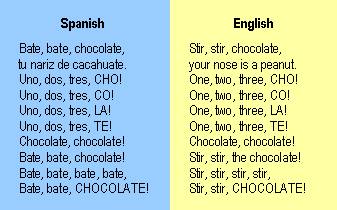
Spanish Children's Rhyme - Chocolate

Today, Mexican children often drink hot chocolate with breakfast and they’ve even got a little ditty called Chocolate that they sing as their chocolate is being prepared and frothed.

A brew of Mexican hot chocolate is very simple to make using the Mexican chocolate available in many American grocery stores. The chocolate comes in hard disks and is made of cacao nibs, sugar and cinnamon. It is course and gritty before it is melted, rather than smooth like American bars, baking chocolates or chocolate chips. It can be found in the ethnic food section. I prefer the Ibarra brand, but Abuelita is a good substitute.

I grew up drinking Mexican hot chocolate and, for me, nothing can compare to a taza (cup) of the slightly bitter, cinnamon, chocolate treat.

Bate, bate chocolate!

Tidbits on Chocolate:

  1. The Mayas and Aztecs made their cacao drinks frothy by repeatedly pouring the liquid from high, back and forth between vessels. Then, the Spanish modeled a molinillo after indigenous whisks to make their chocalatl frothy. Molinillos are available in most Mexican markets and online (see images below).
  2. Some lore indicates that cacao has aphrodisiac effects and that Motecuhzoma Xocoyotzin (“Montezuma”) drank fifty mugs of chocolate a day, especially before entering his harem.

(more…)

Print & If you liked this post, please share:
  • Print
  • email
  • Facebook
  • Twitter
  • StumbleUpon
  • Digg
  • del.icio.us
  • Google Bookmarks

Quinoa: African Peanut Quinoa Soup

Tuesday, January 26th, 2010

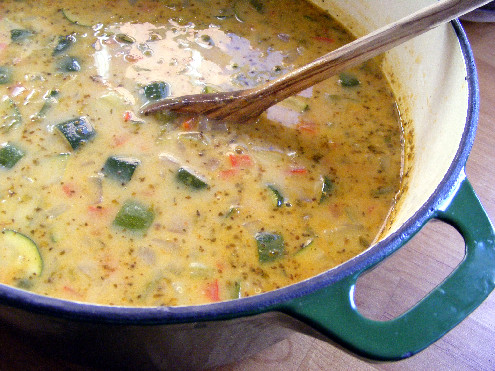
African Quinoa Peanut Soup_ForkFingersChopsticks.com

If you haven’t tried quinoa yet, this toothsome African peanut soup will surely lure you in. It has a slew of nutritious vegetables in a creamy, peppery broth with lovely bits of crunchy quinoa. The soup makes the rotation in my comfort food repertoire several times during the cold-weather season because it is both healthy and decadent.

Although quinoa is native to the South American Andes region (read about its origins), it is now cultivated around the world – from Colorado to the Himalayas to Ethiopia and other areas of East Africa. This dish has a definite African influence – the use of nuts to thicken the stew, and staple ingredients such as sweet potatoes and okra. Frankly, it’s the peanut-based sauce that makes this dish a stand-out. If you don’t like peanuts, you won’t appreciate this dish. But, for nut fiends, you’re in for a treat.

Yes, I’m one of those people who eats spoonfuls of nut butter just because I can. So, when I came across the original recipe for this soup online at FoodDownUnder.com several years ago (the original recipe is no longer on the site), I knew I had to try it. Over the years, I’ve fine-tuned it:  the recipe below is more aggressive with spices and chiles; it also has more veggies, peanut butter and quinoa; and, the consistency is that of a soup rather than a thick stew.

This recipe doubles easily and has been a hit at parties with vegetarians and meat-eaters. It’s a great way to introduce quinoa into your diet. And, if you’re already eating the “Mother Grain,” its a must-have recipe.

Tidbits on Quinoa:

  1. As quinoa cooks, the pearls of germ separate and form tiny spirals. The cooked grain is tender, with a slight crunchiness from the germ (see spirals in image below).
  2. Colorado, with its high altitude and cold climates, was crucial testing ground for introducing quinoa to the United States in the mid-70s. Don McKinley and Steve Gorad, founded the Quinoa Corporation in Boulder, Colo., and first planted quinoa seeds in their backyards and eventually in plots in the San Luis Valley. However, most quinoa sold in the United States is imported from South America.
  3. A quinoa plant can grow to anywhere from three feet to over ten feet tall. Plant stems can be straight or branched, and seeds can vary in color from white, yellow, gray, light brown, pink, black to red.

(more…)

Print & If you liked this post, please share:
  • Print
  • email
  • Facebook
  • Twitter
  • StumbleUpon
  • Digg
  • del.icio.us
  • Google Bookmarks

Black Eyed Peas: Vietnamese Sweet Rice & Bean Pudding – Che Dau Trang

Wednesday, January 6th, 2010

Che Dau Trang Coconut Milk Sweet Rice Bean Pudding ForkFingersChopsticks.com

A lot of folks still make resolutions for the New Year. I’m one of them. This year I’ve vowed to be a better me in 2010. I’m calling it 3B: better, bolder and badder. To do it I’ve got to break away from what’s comfortable and lean toward that which makes me apprehensive. You know the things big and small where you silently say to yourself – maybe I shouldn’t, maybe I can’t or I won’t like it. In 2010, I aim to be open to the possibilities.

This recipe for sweet rice and beans is a step in that direction . . . it’s out of the ordinary for my palate but I was pleasantly surprised. When I was researching black eyed peas and the different cultural preparations for these legumes last month, my brows rose with curiosity when I first learned about che dau trang, a Vietnamese sweet rice and bean dish. See, when I eat Vietnamese, my lips smack for spicy lemongrass sauce, salty fish sauce, pho or bun. But since I’m working on my 3B, I resolved to at least try this sweet bean pudding. And, I’m glad I did.

Che (sweet dessert soups or puddings) is believed to have originated in the central region of Vietnam. Che dau (sweet bean dessert) is made in numerous variations, the name changing with the beans that are used – for example, mung (xanh), azuki (do), black (den) and white/black eyed peas (trang).

Sweet bean desserts are a popular snack food because of their hearty contents – beans and sticky rice. Typically, the black eyed pea version is a bit thicker and sets up like a rice pudding. Since they are also sweet and rich, they are definitely decadent enough to be considered a dessert.  It’s usually enjoyed hot or chilled. Although it is also enjoyed in a tall glass over ice, eaten with a long spoon. An interesting cultural note from Anh, my Vietnamese friend’s momma, is that it is tradition to serve che dau trang when celebrating a baby’s one month birthday.

This is not just novelty fare. I was delighted with my first bite. The beans are cooked just right, not too firm or mushy, and are a nice contrast to the creamy coconut rice. I doubt I could eat but a spoonful after a meal, but I would enjoy this again as a tasty breakfast porridge or as the Vietnamese do – as a snack.

Tidbits on Black Eyed Peas

  1. Black eyed peas are believed to originally hail from Africa or India, and subsequently were grown in Asian countries. From there, they were introduced into the West Indies and to the American South around the 1600s.
  2. Black eyed peas provide a good source of calcium, folate, iron, potassium and fiber.

Source: AsiaRecipe.com (see Vietnam Food History), FoodReference.com, Encyclopedia of Food and History

(more…)

Print & If you liked this post, please share:
  • Print
  • email
  • Facebook
  • Twitter
  • StumbleUpon
  • Digg
  • del.icio.us
  • Google Bookmarks

Black Eyed Peas: Stewed Black Eyed Peas

Tuesday, December 29th, 2009

New Year's tradition

Get ready for the hoopla – banging pots and pans, fireworks, and even firearms shooting off. Yikes! These are just a few of the ways people around the world welcome in the New Year. Originally, these loud rituals were believed to frighten away bad spirits and ensure a good year to come. Me, I’ll be doing something a bit more tame – cooking up a pot of black eyed peas.

Eating black eyed peas on New Year’s Day is a longtime custom among African Americans and Southerners who believe the legumes will bring prosperity and good luck, especially when paired with greens, which symbolize money. Some folks say you just need to eat a spoonful and others say at least 365 (one for each day of the year). Regardless, this year, in this economy, the superstitious dare not skip this tradition.

Some prefer to get their good fortune via a rice and black eyed pea dish called Hoppin’ John. I, however, prefer my peas simmered for several hours until they become creamy. That’s how my in-laws cook them up and how I’ve been eating them for almost two decades. They make a delicious meal served with a dash of Louisiana style hot sauce and maybe some vinegar, along with a generous portion of greens and big ‘ole slice of corn bread.

Black eyed peas can be found in most markets, either dried (found with other legumes), frozen or canned. If you have the time, make them from scratch with this recipe. There really is no substitute. But, if you cannot, opt for the frozen over the canned.

Happy New Year! Below are a few more New Year’s traditions that might pique your interest. Let me know if you have any to share.

Other New Year’s Rituals:

  • Good luck will follow to couples who feed each other grapes during the last 12 seconds of the year. Feed your love interest 12 grapes, representing 12 months in the year; one with each stroke of the countdown and make a wish (Spain and Latin American countries).
  • In you want to travel in the New Year, take your luggage outside and walk around at midnight (Mexico).
  • Eat round-shaped foods such as grapes and prepared desserts for luck; eat noodles for a long life (Philippines).
  • Wear red underwear at midnight for luck with love in the upcoming year or yellow underwear for luck with money (Mexico).
  • For those who are thrill seekers, plunge into icy waters for a polar bear swim on New Year’s Day (Canada).

(more…)

Print & If you liked this post, please share:
  • Print
  • email
  • Facebook
  • Twitter
  • StumbleUpon
  • Digg
  • del.icio.us
  • Google Bookmarks

Rum: Swizzle – Bermudian Holiday Drink

Sunday, December 20th, 2009

Rum Swizzel_ForkFingersChopsticks.com

According to several sources, swizzle is the National drink of Bermuda. If you’ve had it, you know why – it’s divine. The rum, citrus and ginger make for a refreshing libation.

My friend Ernest, whose family hails from Bermuda, says swizzle is a favorite at Christmas and New Year’s festivities (as well as the Cricket World Cup in the summer months). Frankly, after making this drink, it has already become a staple for me and for entertaining.

This recipe honors the three traditional ingredients of swizzle: dark rum, citrus and sweetener. For rum: use a dark one such as the Bermuda produced Gosling’s Black Seal Rum. The heavier body of darker rums stands firm with the bold flavors of the other ingredients. For citrus:  lime, pineapple and orange juice make a slightly tart, yet sweet combo.

And, finally, the sweetener that makes this an A+ cocktail . . . my ginger simple syrup. Although most recipes (including one from the legendary Swizzle Inn in Bermuda) use falernum, a simple syrup infused with almond, ginger and cloves, I could not locate it and knew most of you would have the same problem. So, I improvised and made my own simple syrup that highlighted the ginger and also imparts a nice molasses flavor. It’s good! Next time, I might add a few cloves.

This holiday season I’m glee with my Bermudian Swizzle. Now, if I could just score some cassava pie.

Tidbits on Rum

  1. The climate of the Caribbean is ideal for growing sugar cane and the region has become the epicenter of the world’s rum production with every major island producing signature rums.
  2. When spirits such as rum are removed from breathable barrels, where they mature, and are put into bottles, the rum no longer ages. A bottle of seven-year-old rum purchased five years ago is still considered seven years old.

Sources:  Tastings.com; Encyclopedia of Food and Culture

(more…)

Print & If you liked this post, please share:
  • Print
  • email
  • Facebook
  • Twitter
  • StumbleUpon
  • Digg
  • del.icio.us
  • Google Bookmarks

Rum: Coquito – Puerto Rican Holiday Drink

Thursday, December 17th, 2009

Coquito Holiday Drink_ForkFingersChopsticks.com

For the holidays we’re mixing things up around here. Literally! We’re not “cooking” so much as we’re getting our holiday groove on, imbibing on one of the top selling spirits in the world . . . rum. First up is coquito. A deliciously creamy coconut elixir steeped in spices:  cinnamon, cloves, nutmeg and vanilla. Coquito is standard during the Christmas season in Puerto Rican households, along with pasteles (savory pastries stuffed with meat), pernil (roasted pork shoulder), arroz con gandules (rice with pigeon peas), and tostones (fried plantains).

Much like eggnog, coquito is a rich holiday drink meant for sipping and savoring. A little goes a long way, especially because it’s loaded with several tasty ingredients like coconut milk and sweetened condensed milk. And, it contains a good dose of rum.

As customary with all things scrumptious, there are a plethora of ways to make coquito. Recipes are tweaked from generation to generation and person to person for a signature twist. More traditional versions require cracking coconuts and fresh eggs. My recipe, however, is much simpler using canned coconut milk and nixing the eggs (no need to drink raw eggs or deal with a double boiler). I’ve also added almond extract for another bold dimension.

Although there is talk of a coquito throwdown in these parts next year, my hermanas Puerto Rican and Boriqueñas were kind enough to let me in on a few tips:  1) cutting the eggs out is not sacrilege and 2) using Coco Lopez® cream of coconut makes for a much sweeter drink. Note, I’ve had plenty of versions of coquito that I found both too rich and sweet, so I use regular coconut milk instead of Coco Lopez®.

This coquito tastes like a tropical Christmas. If you can’t be on the island, taste it. For optimum flavor, make note to make this at least a day ahead.

Salud!

Tidbits on Rum:

  1. Rum is derived from sugarcane. Essentially, when sugarcane is crushed, the juice that is extracted is boiled and separates into crystallized sugar and a remnant sugary liquid known as molasses. The molasses is further distilled and aged to make rum.
  2. Fermenting and distilling sugarcane to make beverages dates back thousands of years to China, Egypt, India, Syria, Southeast Asia and the South Pacific.
  3. About 80 percent of the rum consumed in the United States is from Puerto Rico.
  4. Rums come in light (silver) and dark (gold). Most light rums are produced in Puerto Rico, while the darker versions come from Jamaica.

Sources:  The Oxford Encyclopedia of Food and Drink in America; The Encyclopedia of Food and Culture.

(more…)

Print & If you liked this post, please share:
  • Print
  • email
  • Facebook
  • Twitter
  • StumbleUpon
  • Digg
  • del.icio.us
  • Google Bookmarks

Sweet Potato: Jamaican Sweet Potato Curry

Wednesday, December 9th, 2009

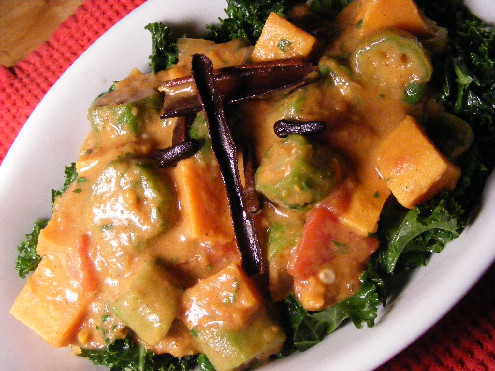
Jamaican Sweet Potato Curry_ForkFingersChopsticks.com

What kind of sweet potato person are you? A. Eat sweet potatoes at Thanksgiving meal and don’t eat them otherwise; B. Eat sweet potatoes year round; C. Don’t eat sweet potatoes. I predict most folks fall into the holiday eater group and these lovely tubers get ignored the rest of the year. What a shame because they are nutritionally loaded with Vitamins A and C. And, the better part (for some), they taste great even under the simplest of cooking methods (boiled or baked) and without added fats and spices.

Here, however, we’re using the spice rack . . . Jamaican style! Sweet potatoes are simmered in a warm spice mixture common to Carribbean cuisine:  ginger, cardamom, cinnamon, cumin, cloves and allspice. Then, it’s made luscious with coconut milk. For an added touch of Caribbean influence, I’ve added okra and I served it all on a bed of sautéed kale, since it was easier to locate in my neighborhood than the Jamaican spinach callaloo.

This is a vegetarian curry that can be enjoyed as a main or a side. It’s nutritious comfort food when the weather outside is frightful. It is hearty akin to the consistency of a thick butternut squash soup. And, the taste  is deep – the Indian influence is certain. Each spoonful makes me close my eyes and long to transported to an island far away.

The recipe is adapted from the Jamaican Fish Curry recipe in one of my favorite cookbooks, The Caribbean: Central & South American Cookbook by Jenni Fleetwood and Marina Filippelli (2007). It’s definitely a go to book for Caribbean cooking with make-you-want-to-cook recipes, beautiful photography and easy instructions.

Enjoy! With this dish I bet some C. types would convert.

Tidbits on Sweet Potatoes

  1. The origin of sweet potatoes is believed to be located in Central America with its ancestral roots in the Mexican wild yam. They have been cultivated for more than 5,000 years, although fossilized remains in the Andes date back 8,000 years.
  2. Sweet potatoes were the second most important root crop in the United States at the beginning of the twentieth century. In 1920, per capita consumption was 31 pounds. In 1999, consumption dropped to a mere 4 pounds per person.
  3. China grows about 87 percent of sweet potatoes grown worldwide; with nearly half used as feed for animals. Asia produces 6 percent, Africa 5 percent, Latin America 1.5 percent, and the United States 0.45 percent.
  4. Sweet potato flesh comes in a spectrum of colors: white, yellow, purple, red, pink, violet and orange. Nutritionally, all varieties are good sources of Vitamins C and E as well as dietary fiber, potassium, and iron, and they are low in fat and cholesterol. The orange and red fleshed sweet potatoes are an excellent source of beta-carotene (Vitamin A).

Source: Encyclopedia of Food and Culture.

(more…)

Print & If you liked this post, please share:
  • Print
  • email
  • Facebook
  • Twitter
  • StumbleUpon
  • Digg
  • del.icio.us
  • Google Bookmarks

Sweet Potato: Andrea’s Easy Sweet Potato Pie

Sunday, November 22nd, 2009

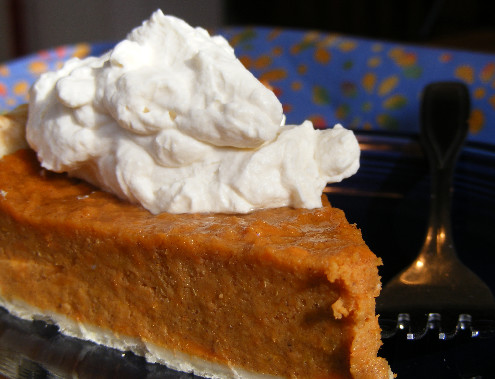
Sweet Potato Pie_ForkFingersChopsticks.com

Sweet potato pie is relatively new to my Thanksgiving repertoire. I grew up with pumpkin pie for the holiday and, to be frank, I never really dug it. It was pretty much bland and boring in my book. However, years ago when I began dating my, now, husband and had Thanksgiving with his family, I delighted on an entirely different Thanksgiving feast:  greens, black eyed peas, corn bread dressing, macaroni and cheese, and yes, the consummate of Soul Food desserts – sweet potato pie.

The bold nutmeg, cinnamon and sweet potatoes won me and my momma over instantly. Since then, I’ve been making sweet potato pies for Thanksgiving. I’ve tweaked my recipe over the last several years. It’s almost home-made (I buy a lovely frozen crust). Actually, it’s more like six because I bake enough pies to share with my large, extended family across two states. I can make pie crust from scratch, but why? Sometimes in life, shortcuts are worth it. I’d rather go for a walk than sweat the small stuff, especially with the stress and extra calories that come with the holidays.

This is an easy recipe, it just takes a couple of hours to do the boiling and baking. Don’t worry, you don’t have to hover over the stove, you can multi-task with this one. Don’t be tempted to buy the canned puree; that short cut is not worth it.

And, one more thing, this pie is damn good! There’s never a leftover, except for a few crumbs, if even that.  This year, I’m topping it with home-made vanilla whipped cream and an extra dash of nutmeg. Note at our house, we enjoy sweet potato pie beyond Thanksgiving and the holidays, it’s delicious with a hot cup of tea, chai or coffee. I like mine room temperature and the husband likes his cold.

Tidbits on Sweet Potatoes

  1. There is some confusion between sweet potatoes and yams, particularly in the U.S. In American grocery stores, what are marked and we understand to be “yams,” including the garnet and jewel varieties, are actually sweet potatoes.
  2. Sweet potatoes spoil quite easily, especially when bruised and wet. Keep them fresh for weeks by storing them in a cool dry place like a pantry or cellar. Do not wash before storing since moisture speeds up spoiling. Do not refrigerate as well.

(more…)

Print & If you liked this post, please share:
  • Print
  • email
  • Facebook
  • Twitter
  • StumbleUpon
  • Digg
  • del.icio.us
  • Google Bookmarks

Cabbage: Beef & Cabbage Soup – Caldo de Res

Wednesday, November 18th, 2009

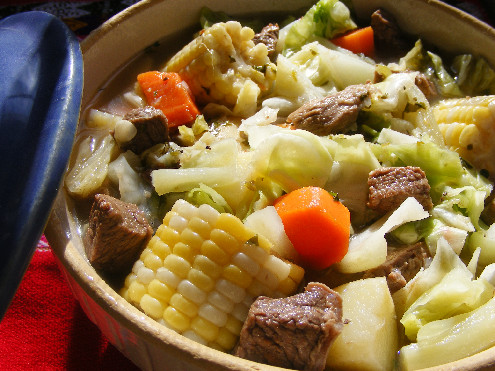
Caldo de Res_ForkFingersChopsticks.com

There are certain dishes that make me nostalgic for childhood.

You know what I’m talking about. A smell or taste that conjures vivid memories of comfort – when life was more simple and childhood dramas were easily soothed by your momma or daddy’s home-made goodies. Like, a bandage and a kiss or hug, but you could eat it. For me, these cabbage recipes have been just that:  the yeasty smell of my mom’s cabbage burgers baking, warming the house and our tummies on a cold day; and, this beef and cabbage soup from my abuela Juarez.

Grandma Juarez is no longer with us. And, I’m sure, I’m not the only one of the 37 grandkids and 46 great-grandchildren who thinks of her when I eat this soup. I remember several a Sunday afternoon visit and her never-empty pot of soup simmering in her little kitchen. Somehow it managed to feed whomever stopped by that day. That, and tortillas de harina (flour tortillas), but that’s another recipe and story.

Caldo de res is comfort soup, perfect for a dreary day or cool night. Tender bites of roast simmered in a beefy broth with winter vegetables – onion, cabbage, potatoes and carrots. It’s a standard in Mexican households and restaurants, although the ingredients may vary slightly – some adding chayote or zucchini.

The recipe below is adapted from my abuela’s recipe (I use a whole head of cabbage and more veggies, and brown the roast first). It also contains her rumoured “secret” ingredient (which, now, is no longer secret), hierba buena, spearmint used in Mexican teas and cooking. It adds a special, fresh dimension to this soothing broth.

For those who’ve never tried caldo de res, if you like Vietnamese pho, which also has a tasty beef broth, you’ll want to try this soup.

Tidbits on Cabbage:

  1. When shopping for cabbage, look for one with a shiny, crisp exterior. It should also feel solid and compact. Avoid buying those that look wilted, brown or dried-out.
  2. Don’t wash cabbage until you are ready to use it. Cabbage can be rinsed after cutting or chopping, drain well.
  3. Boiling cabbage tenderizes the leaves, causing it to release sugar and the characteristic cabbage aroma.

(more…)

Print & If you liked this post, please share:
  • Print
  • email
  • Facebook
  • Twitter
  • StumbleUpon
  • Digg
  • del.icio.us
  • Google Bookmarks