Archive for the ‘By Origin’ Category

Cabbage: Cabbage Burgers – Runzas & Bierocks

Friday, November 13th, 2009
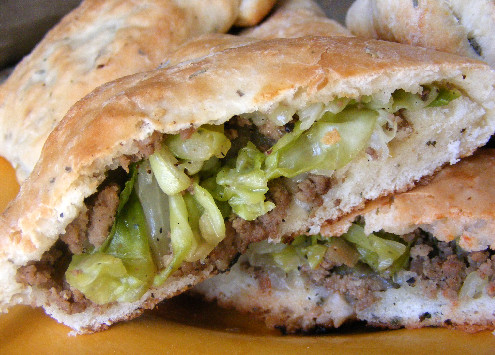
Cabbage Burger _ Runza - Bierock_Fork Fingers Chopsticks.com

This recipe pays homage to my Nebraska roots . . . When you think about the state, what first comes to mind? For most it’s corn, Big Red football and Omaha Steaks®. Now, after you read this post, you’ll be adding cabbage burgers to the list.

They are individual-sized, savory yeast bread stuffed with peppered beef, cabbage and onions; baked golden brown. Simple ingredients and spices that make for a comforting, satisfying meal. For those not in on these little treasures, think calzone, empanada or pierogi rather than a typical burger. In Nebraska, they are also called cabbage buns or runzas; in Kansas, bierocks.

At the turn of the nineteenth century, cabbage burgers were introduced to the mid-west by German Russians (Volga Germans) who immigrated to the U.S. and settled primarily along the plains of Nebraska and Kansas. Since then, they have been notable, regional fare. Runza®, a Nebraska fast-food franchise, serves them up in a variety of flavors.

Growing up, my Mexican family ate plenty. I suspect it’s because the pillowy treats provide a good way to stretch a pound of ground beef. When my mom baked a batch, they were heavier on the cabbage than beef. I still like ‘em like that. No surprise, I’m a big fan of cabbage – raw and cooked. This recipe comes from the bread maker in my family, my sister Monica.

All you Huskers, I expect a shout out on this one. Leave a comment about how you eat your cabbage burgers.

Tidbits on Cabbage:

  1. Cabbage belongs to the Cruciferae family of vegetables along with kale, broccoli, collards and brussels sprouts. There are an estimated 100 different varieties of cabbage grown in the world. The most common types in the U.S., however, are the green, red, savoy and Chinese varieties – bok choy and napa.
  2. Cabbage is estimated to have been cultivated more than 4,000 years and domesticated for over 2,500 years. It is believed to have originated from wild loose-leaf cabbage brought to Europe around 600 B.C. by groups of Celtic wanderers. Since it is a cool weather crop and stores well during winter, it soon became a major crop in Europe – particularly in Germany, Poland and Russia.
  3. Cabbage has several health benefits:  phytonutrients in cabbage and other crucifers help the body detoxify; cabbage is an excellent source of vitamin C, as well as good source fiber, manganese, folate, vitamin B6, potassium and omega-3 fatty acids.
  4. Since phytonutrients react with carbon steel and turn cabbage leaves black, use a stainless steel knife to cut.

(more…)

Print & If you liked this post, please share:
  • Print
  • email
  • Facebook
  • Twitter
  • StumbleUpon
  • Digg
  • del.icio.us
  • Google Bookmarks

Pear: Lamb & Pear Tagine

Tuesday, November 10th, 2009

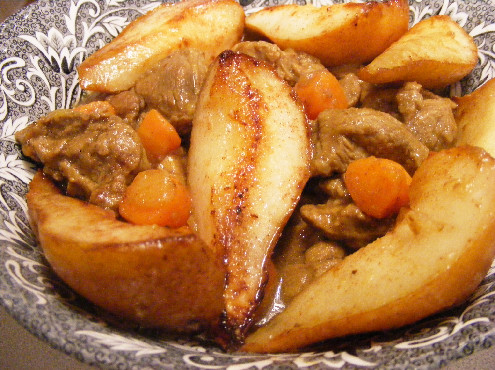
Tagine Lamb Pears_ForkFingersChopsticks.com

Golden, sautéed pears served with slow-cooked, tender lamb spiced with cinnamon, ginger and pepper. Sounds delicious right? It is, as eaten and attested by several friends who gobbled up this tagine.

Moroccan food is one of my favorites because I enjoy the array of spices and ingredients used throughout the cuisine:  cinnamon, cumin, ginger, pepper, coriander, paprika, saffron, mint, lemon and more. Also emblematic of Moroccan cooking is the tagine (tajine), a stew that takes its name from the cooking vessel stews were traditionally cooked in – a shallow, round earthenware base with a cone shaped lid. It is standard in North African homes, and probably most well-known in Morocco cooking. Today, the name “tagine” is also commonly used to refer to stew, as many modern Moroccan cooks now use pressure cookers.

Characteristic of savory Moroccan meat tagines is the inclusion of fruit – raisins, quinces, prunes, dates, apples and, yes, pears – this week’s featured ingredient. However, in my exploration to bring you a new use for pears, I overlooked one thing – I’m not a fan of lamb. But, my labor and intuition in the kitchen was not for naught. The stew got the thumbs up among several lamb aficionados, with particular accolades for the pears.

The recipe here is adapted from several cookbooks including Arabesque: A Taste of Morocco, Turkey, & Lebanon by Claudia Roden; Couscous and Other Good Food from Morocco by Paula Wolfert; and Casablanca Cuisine: French North African Cooking by Aline Benayoun.

This tagine makes for a comforting meal with complex flavor and texture – tender lamb with a warmly-spiced, glossy sauce, and soft, sweet pears.

Tidbits on Pears:

  1. Pears’genus Pyrus, native to the Northern Hemisphere of the Old World, includes about 20 species, of which half are found in Europe, North Africa, and Asia minor; and the remaining half in Asia.
  2. In some Asian cultures, pears and pear trees were believed to ward off evil. In Egyptian antiquity, the fruit was sacred to Isis, and to Koreans, the pear symbolized grace, nobility and purity, according toThe Pear in History, Literature, Popular Culture, and Art by Jules Janick.

(more…)

Print & If you liked this post, please share:
  • Print
  • email
  • Facebook
  • Twitter
  • StumbleUpon
  • Digg
  • del.icio.us
  • Google Bookmarks

Green Chile: Roasted Chile In Cream – Rajas Con Crema

Friday, October 30th, 2009

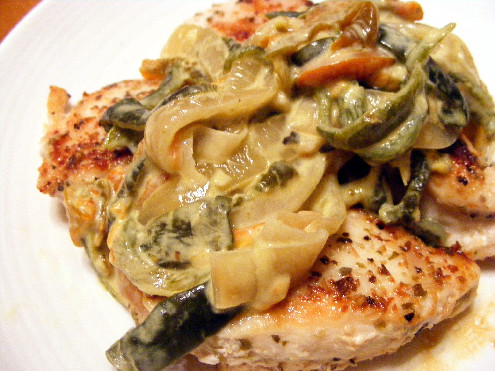
Rajas con Crema _ Chicken

This recipe is for all you cream sauce lovers. Rajas con crema is a winner – smoky, spicy chiles rounded by a simple rich cream sauce. And, it’s super easy to make, especially if you cheat and get your chiles pre-roasted.

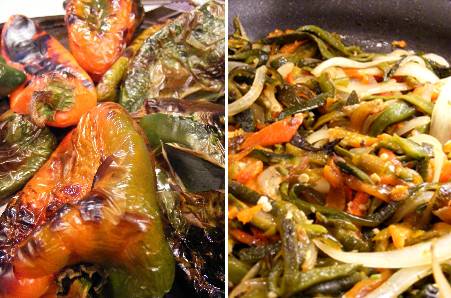
The inspiration for this recipe came last month when I went to my friend Laura’s annual Mexican Independence potluck pachanga (party). That night I made my way to the food line one time too many – each time scooping a spoonful of rajas. Rajas con crema, literally translates to mean “slices with cream.” Aesthetically, it was the perfect dish for her party representing the colors of the Mexican flag, green and red from the roasted chiles and white from the onion. Gastronomically, it was scrumptious.

Here’s my version of rajas con crema using crema Mexicana, Mexican cream, to give it richness. It is thick and slightly acidic, definitely more decadent than regular sour cream.

I used roasted poblano chiles and, just to be sure it had enough kick, I also used a couple of roasted hot Hatch chiles. The ultimate result is a spicy creamy combo that is sure to please, either as vegetarian taco filling, a side with rice and beans or served on top of grilled chicken or steak (as pictured above).

Tidbits on Chile

  1. Chiles are believed to have originated in South America in an area bordered by the mountains of Brazil and Bolivia.
  2. Chile peppers are the most popular spice and condiment in the world, consumed daily by one-quarter of the world’s population.
  3. Raw green chile has more vitamin C than citrus fruits.
  4. Chile heat levels (capsaicin) is determined by a plant’s variety and the environment where it grows. The amount of capsaicin will increase under dry, stressful conditions.

Sources:  Encyclopedia of Food and Culture and the Chile Pepper Institute of the University of New Mexico.

Combo Image - Roasted Peppers _ Sauteed with Onion

(more…)

Print & If you liked this post, please share:
  • Print
  • email
  • Facebook
  • Twitter
  • StumbleUpon
  • Digg
  • del.icio.us
  • Google Bookmarks

Green Chile: Green Pozole

Sunday, October 25th, 2009

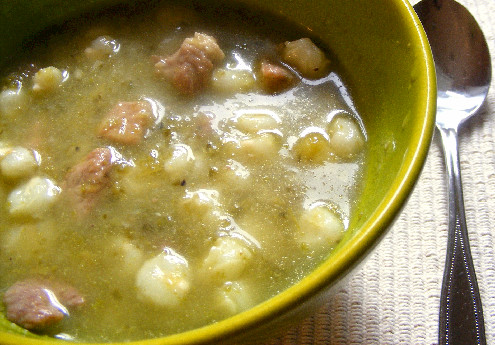
Bowl of Green Pozole

For the past several years, I’ve had cooking a good pot of pozole on my list of things to do. If you’ve never had it, you’re missing out. Pozole, also spelled posole or posolli, is a hearty Mexican soup that’s typically made with pork, hominy and chiles, and traditionally eaten around Christmas, although nowadays more regularly. It’s also believed to be a good hangover remedy.

Hangover or not, this soup is gooooodddd. Alone it’s luscious – spicy from the chiles, earthy from the hominy and rich from tender pieces of pork roast. Then when you sprinkle it with dried oregano, fresh lime juice, bits of onion, crispy cabbage and whatever else you flavor, it gets even better.

I’ve looked for inspiration while eating out but have been repeatedly disappointed because I had my heart and taste buds set on a green or clear pozole that was both light and satisfying – something resembling the version I had over 10 years ago with a friend from New Mexico. I prefer the green version over the red for two reasons: red pozole is almost like menudo (another Mexican soup with hominy) and a lot of folks get heavy handed with the red chile, which can get pungent.

So, when my girlfriend Chelby and her husband Don hooked me up with this green chile version, I knew I had to give it a go – the two know good grub (I think it’s a Texas thang) and Don’s version doesn’t have tripe (stomach lining), which I don’t mind eating on a rare occasion but will reserve for my menudo.

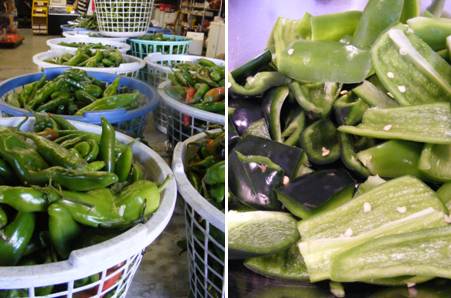
Green chiles are a staple ingredient in most Southwestern kitchens. And, early fall is prime time for folks to buy them by the bushel, fresh or roasted. Last week I got my loot:  some Hatch, poblanos, and Anaheim – perfect for this recipe. Note, we’re using fresh, raw chiles for this soup.

Chiles Raw _ Chopped

Hatch chiles hail from Hatch, New Mexico, which has built a reputation as the Chile Capitol of the World among some. For this recipe, Don recommends Hatch chiles, which are more medium to hot on the Scoville Scale. If you can’t find them, substitute with poblano chiles, also called pasillas, which are typically milder. Poblanos are commonly used roasted and stuffed for popular dishes like chile rellenos.

Besides the chiles, the other star ingredient in this dish is hominy, called cacahuazintle in Nahuatl. It’s a natural variety of white corn with large kernels that is about four times the weight of regular corn kernels. Its taste is distinctive, earthy like that of corn in corn tortillas rather than the sweet flavor of corn in corn of the cob.

This recipe is easy to make, despite the length of this post. Enjoy! And, let me know if Don and I’ve converted any of you red pozole lovers.

Tidbits on Green Chile

  1. Green chile is generally a reference to its fresh state and red chiles refer to those that have dried. Generally, as chiles grow, they start off green and turn red or yellow.
  2. Chiles retain their heat level regardless of whether it is cooked, dried or frozen. When using fresh, to reduce the amount of heat, remove the seeds and veins. And, be sure to avoid touching your eyes and other sensitive areas after handling.
  3. “Hatch” chiles are not a variety of chile pepper, but rather a reference to where they are grown, according to the Chile Pepper Institute of the University of New Mexico.

(more…)

Print & If you liked this post, please share:
  • Print
  • email
  • Facebook
  • Twitter
  • StumbleUpon
  • Digg
  • del.icio.us
  • Google Bookmarks

Green Tomatoes: Chow Chow – Pickled Relish

Monday, October 19th, 2009

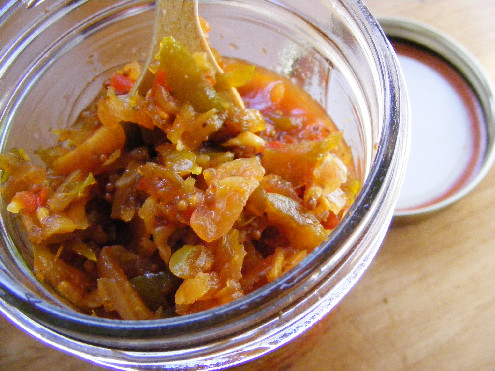
Chow Chow Relish_Green Tomatoes

I confess that even though I lived in the South (Austin, Texas) for several years and am married to a brotha, I’d never eaten chow chow until last summer. Chow chow, also called “cha cha” or “piccalilly” in some parts, is a pickled relish of chopped vegetables that has its origins in Southern fare and Soul Food. As with the name, there are many variations of the relish but nearly all contain green tomatoes, cabbage, onions and peppers.

All you gardeners, who salvaged your summer veggies before the freeze and now have green tomatoes laying about willy-nilly, should give this recipe a go.

For this recipe, I got some direction from my friend Tony, a man of many talents – artist, athlete, handy-man and cook. He graciously shared a recipe and some of his chow chow. His version is greener, in line with tradition, and it’s sweet (think Southern sweet tea sweet) especially when eaten alone. But, on a burger, it’s delish and a good addition in a marinade for grilled chicken, because the sugar caramelizes nicely.

My version, adapted from Tony’s, is spicier, less sweet and has a reddish hue (I used my garden bounty – red cabbage and more red and yellow bell peppers). It also  has a bit of a  “wang” because I used Thai and serrano chiles from my garden. Next time I have a hankering for a pickled relish – I’ve got my own.

Tidbits on Green Tomatoes:

  1. Tomatoes and other nightshade plants like eggplants were grown on Southern plantations decades before acceptance in other colonies or England, according to The Oxford Encyclopedia of Food and Drink in America.
  2. There’s some debate about the origins of the name “chow chow,” some say it comes from the Mandarin Chinese word cha, which means mixed, and dates back to the 1840s when Chinese laborers worked the railroads in the American West. And, others say it is derived from the French word for cabbage, chou.

(more…)

Print & If you liked this post, please share:
  • Print
  • email
  • Facebook
  • Twitter
  • StumbleUpon
  • Digg
  • del.icio.us
  • Google Bookmarks

Green Tomatoes: Bacon Lettuce & Fried Green Tomato Sandwich

Wednesday, October 14th, 2009

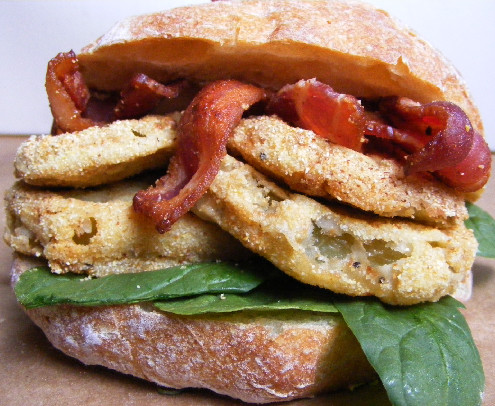
BLFGT Stacked

Fried tomatoes are an oxymoron of sorts, don’t you think? A garden fresh, healthy vegetable battered and fried. Pure indulgence, especially when paired with bacon.

In the South, a regular breakfast phenomenon is bacon and eggs served alongside fried tomatoes (green or red), according to John Egerton in his book Southern Food: At Home, on the Road, in History, which is considered a classic.

Not one for cooking such a “big” breakfast, an alternative was a must. This recipe is a modern twist on the consummate of sandwiches, the BLT, and keeps with Southern tradition by uniting fried green tomatoes and bacon in new form. The sandwich is surprisingly good – crisp and salty bacon, creamy garlic mayo, fresh lettuce (although I used spinach), and slightly tangy, crisp green tomatoes – together they are a mouthful of flavor.

Enjoy! Then go for a walk afterward to compensate.

(more…)

Print & If you liked this post, please share:
  • Print
  • email
  • Facebook
  • Twitter
  • StumbleUpon
  • Digg
  • del.icio.us
  • Google Bookmarks

Zucchini: Turkish Fritters – Kabak Mucveri

Sunday, October 11th, 2009

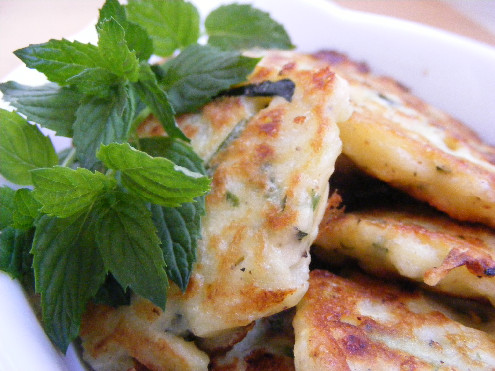
Turkish Zucchini Fritters

You probably have plenty of recipes that call for zucchini baked, grilled and stewed. I do too. So the first time I tasted a zucchini fritter at a community garden potluck, I was thrilled and inspired to do some research . . . What’s a fritter?

Technically, something that’s coated in a batter and fried. There are a lot of versions out there, most calling for grated zucchini in a batter with some sort of cheese. Personally, I’ve become partial to the Turkish version, Kabak Mucveri, because I really like feta and mint. Kabak Mucveri is typically eaten as a hot or cold appetizer and is served among several fingerfoods as a meze like tapas, but it’s also a great side dish. In Turkish cuisine, vegetables shine.

My version is light but not skimpy on flavor (I ate five the first time I made them). They have a crunchy outside and a flavorful center with the zucchini slightly crisp and bits of sharp feta and refreshing herbs in every bite. I prefer them served hot but they are also yummy at room temperature.

Tidbits – Zucchini:

  1. Since squash was domesticated in the Americas, most summer squash were introduced to the Old World after 1492, the time of European colonization. To the Romans, squash resembled other cucurbits belonging to other plant species and became integrated into the Mediterranean diet. Squash received the name of “calabash” and in Syria was called “zucco.” From this comes its present-day name, zucchini, according to the Encyclopedia of Food and Culture.
  2. Squash is now cultivated throughout the Americas, Europe, Africa, the Middle East, China, India, and Indonesia.
  3. Zucchini has a high water content (95%), which makes the vegetable low in calories – about 25 calories per raw cup and nutritionally contain folate, potassium, and vitamins A and C.

(more…)

Print & If you liked this post, please share:
  • Print
  • email
  • Facebook
  • Twitter
  • StumbleUpon
  • Digg
  • del.icio.us
  • Google Bookmarks

Zucchini: Mexican Succotash – Calabacitas Con Elote

Wednesday, October 7th, 2009

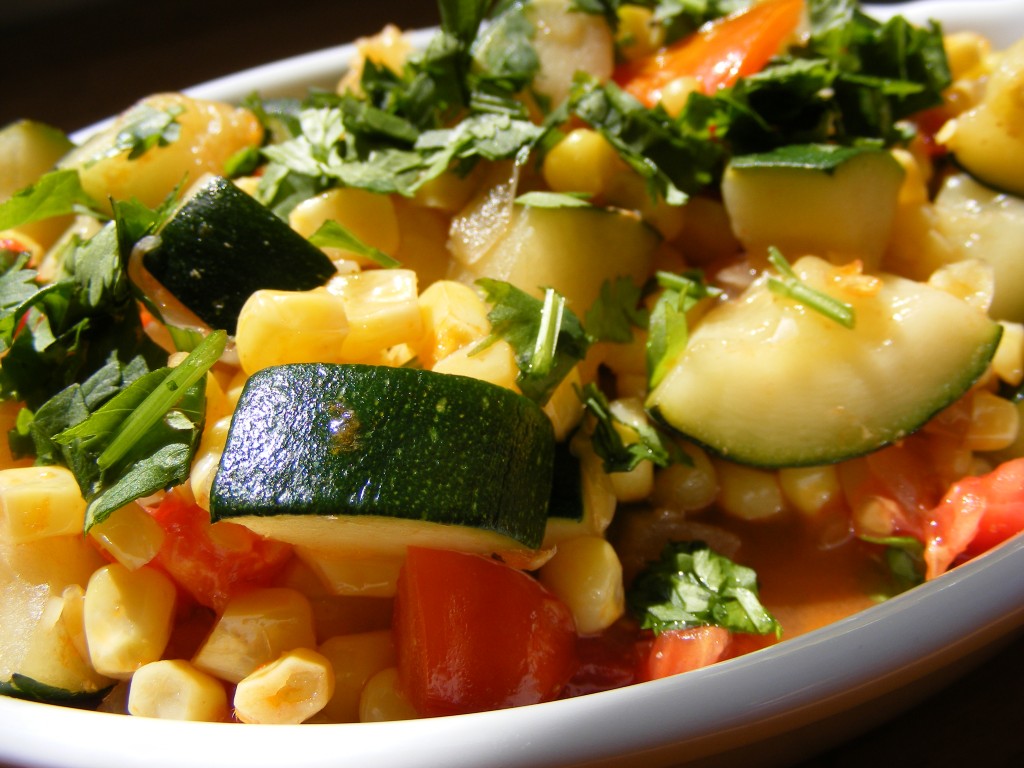
Calabacitas con Elote - H

Zucchini? Yes, zucchini. I’m launching my food blog with this humble, under-appreciated summer squash. Why? Because it’s used way, way too much to make stuff like zucchini bread (although I do make my own version). And, some folks are itching for another way to use all those zucchini that proliferate the gardens and markets this time of year. I know what you’re thinking . . . blah. But, you’re wrong.  It’s all about how it’s prepared.

In this recipe, the zucchini’s fresh, buttery taste is complimented by crisp corn kernels and the sweet juices of tomato and Mexican seasoning. It’s basically a succotash and it’s been served up in my family and other Mexican kitchens for generations.

This is comfort food more often eaten at home rather than in Mexican restaurants, especially those in the States, where the menu favors greasy, fried tacos over vegetables. This dish is just some of the healthy Mexican food I enjoy and it’s quick and easy to make. Of course there are many variations of calabacitas – some omit the corn, others the tomatoes. I like it with both.

Tidbits on Zucchini:

  1. Squash was domesticated as early as 10,000 B.P in central Mexico and Peru, as well as other parts of the Americas. As such, squash was an integral staple in Mexican cuisine, along with corn and beans, according to the Encyclopedia of Food and Culture.
  2. The word calabacita is derived from the Spanish word calabaza, meaning squash; the diminutive “ita” changes the meaning to little squash.
  3. Zucchini is like the tomato – botanically a fruit but thought to be a veggie.

(more…)

Print & If you liked this post, please share:
  • Print
  • email
  • Facebook
  • Twitter
  • StumbleUpon
  • Digg
  • del.icio.us
  • Google Bookmarks