Lentils: Comforting Red Lentil Soup

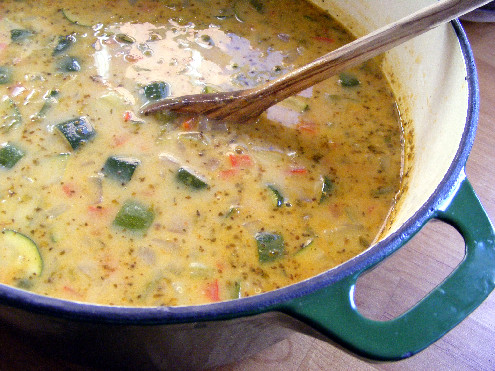
Red Lentil Soup_ForkFingersChopsticks.com

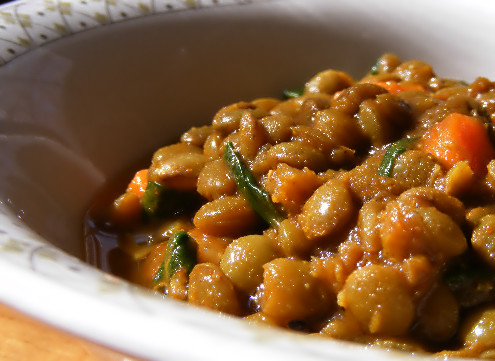
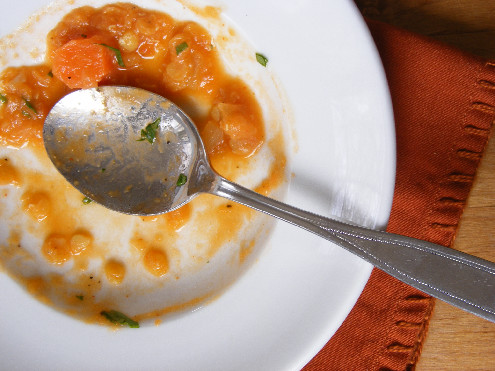
This red lentil soup is comfort food.

It takes the edge off a cold, winter day and satiates my panza (belly).

It’s a souped-up tomato soup – made hearty with red lentils and flavorful with my favorite warming spices:  ginger, cumin and chile.  Several Ethiopian red lentil dishes are similar; this one is more simple.

Last month, I made a jumbo batch for a New Year’s snowshoe group outing. It was a crowd pleaser. After trekking steep hills in gusty winds at 11,000 ft., we huddled near a fire pit warming cold fingers and toes. And, we grubbed! Hot chocolate, hot ginger tea, home-made sweets, grilled spicy sausage on sticks and, yes, red lentil soup. It was a wonderful way to start the New Year – outdoors, warm and belly full.

Red lentils cook faster than other lentils because they are hulled. Although they are referred to as red, they are actually a salmon pink hue. When cooked, the discs turn golden and are delicate, which makes them well-suited for purées or soups.

This lentil soup is a filling main course especially when served with crusty bread. It’s also a nutritious side dish with a sandwich (or sausage on a stick).

Tidbits on Lentils:

  1. Lentils’ botanical name Lens culinaris means cooking lens, a reference to its convex shape.
  2. Up until the later part of the last century, lentils and other beans were generally stigmatized as peasant food – they were staples to those who could not afford meat. However, in places like Egypt, there were aficionados who were particularly fond of red lentils. In India, where vegetarianism was prominent, lentils were also integral to diet.

Source:  Beans: A History by Ken Albala

View recipe for Lentils: Comforting Red Lentil Soup
Print & If you liked this post, please share:
  • Print
  • email
  • Facebook
  • Twitter
  • StumbleUpon
  • Digg
  • del.icio.us
  • Google Bookmarks

Lentils: Easy Dal – Indian Lentil Stew

Easy Dal_ForkFingersChopsticks.com

Growing up Catholic, lentils were standard in my house every Lenten season. Now, as an adult, I eat them year-round but more frequently during the colder months in hearty soups and other comforting dishes. Although some of you may be scrunching your nose about now, don’t. They make for good eating. Yes, lentils prepared inadequately can be boring and flavorless – perhaps why they get associated with deprivation. But, spiced right, they are oh so scrumptious and uber healthy.

For inspiration on cooking lentils, I look toward India, Pakistan and other countries in the Indian subcontinent, where lentils are integral to diet and dal.

Simply speaking, a dal (also spelled dahl, daal or daahl depending on the specific region) is a stew made from legumes such as lentils and is typically seasoned with turmeric, ginger, and other spices. It is enjoyed with roti (flatbread), fragrant basmati rice, and vegetables.

Traditional dal requires making lentils from scratch. Even though they cook relatively fast compared to other legumes, we’re keeping it simple. Pre-made lentils and a handful of other ingredients (that are likely in your pantry) are all that is needed. This easy recipe is a healthy go-to-meal for those nights when you want something home-made but don’t want to spend hours in the kitchen. It takes about 15 minutes to prepare.

Try this dish as an alternative for a Lenten Friday meal or, if you’re like me, anytime.

Tidbits on Lentils:

  1. Lentils are believed to have originated from Eastern Turkey and Northern Syria and are thought to be one of the first crops cultivated by man. They have been a food source for over 8000 years, although wild lentils, dating back 11,000 years, have also been found in a Greek cave.
  2. There are at least 50 cultivated varieties of lentils that come in various forms (split versus whole), various sizes, and an array of colors including yellow, red, green, brown and black.
  3. Lentils are often considered a good substitute for meat and have gained popularity as a Lenten food. These legumes are a good source of lean protein. They are a complete protein paired with grains, nuts, seeds, eggs and dairy products.

View recipe for Lentils: Easy Dal – Indian Lentil Stew

Print & If you liked this post, please share:
  • Print
  • email
  • Facebook
  • Twitter
  • StumbleUpon
  • Digg
  • del.icio.us
  • Google Bookmarks

Chocolate: Red Velvet Cacao Nib Cupcakes

Red Velvet Cupcake with Cacao Nibs_ForkFingersChopsticks.com

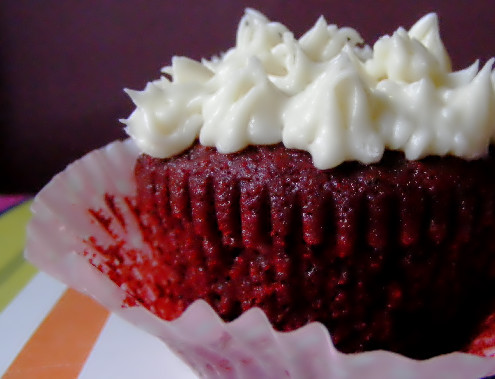
Red velvet cake is a Southern classic. It is neither a traditional vanilla cake nor chocolate cake. Yet, cocoa powder is an essential ingredient and the reason why it’s included with my chocolate recipes. That and it’s perfectly gorgeous for Valentine’s Day.

As the name suggests, the cake has a velvety tender texture that is moist and brilliantly red with a subtle chocolate tone. When topped generously with a cream cheese frosting, it makes for a striking contrast.

Instead of a full-on cake, I made cupcakes. They are less formal than a three-layered cake and perfect for sharing with family and friends. Cupcakes were also conducive to cacao nibs – my twist for oomphing up the chocolate factor. It’s not completely traditional but it’s fun.

As for the origins of red velvet cake, the exact history is a bit head-spinning but alluring for foodiephiles . . . Some researchers believe the pinkish-hued chemical reaction that occurs when cocoa powder is mixed with vinegar and/or buttermilk made a precursor cake that was eventually augmented with food coloring. Other researchers point to the rations of World War II, when beets were used to brighten the color of cakes. And, there’s even some food lore involving the Waldorf Astoria and a woman in the 1920s who was billed an exhorbitant amount when she requested their recipe. Apparently, furious, she copied the recipe and distributed it generously. And, still others suggest the cake’s origins are in Canada tied to Eaton’s department store.

Despite all that, I was first introduced to red velvet cake by my husband’s Aunt Gloria. What I remember most about her cake was how lovely it looked sliced and the hint of chocolate and tangy frosting with each bite. She’d make her cake, freeze it and bring it on the plane to Colorado. Now, that’s love. The recipe below is adapted from Aunt Gloria’s family recipe.

Show love this Valentine’s Day . . . Eat chocolate in its many forms.

Tidbits on Chocolate:

  1. Chocolate has an American annual per capita consumption of around 14 pounds per person.
  2. Although not true legumes, cacao seeds are frequently called “beans.”
  3. Typically in the United States, “cacao” is used to refer to the tree and its dried seeds prior to further processing.  “Cocoa” refers to the partially defatted, roasted, and ground cacao seeds. “Chocolate” is generally used to refer to a food prepared from roasted cacao seeds. “Cacao nibs” are unsweetened raw pieces of cacao beans, they are crunchy bits that taste slightly nutty with notes of bitter chocolate.

View recipe for Chocolate: Red Velvet Cacao Nib Cupcakes

Print & If you liked this post, please share:
  • Print
  • email
  • Facebook
  • Twitter
  • StumbleUpon
  • Digg
  • del.icio.us
  • Google Bookmarks

Chocolate: Easy Chicken Mole Poblano

Mole Poblano_ForkFingersChopsticks.com

Hooray for mole (pronounced MOH- lay)!

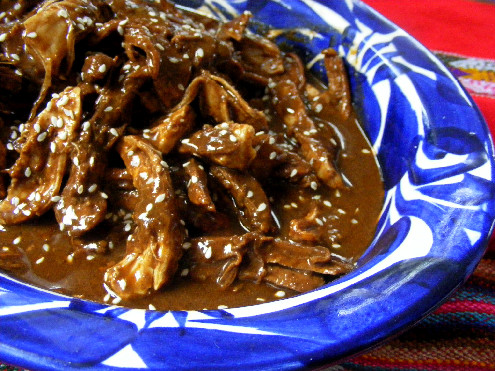
If you’ve never feasted on mole poblano, you must. It is so beloved it is considered the national dish of Mexico. Mole poblano is a dark, rich, thick, sauce served over chicken or turkey – it’s both bitter and spicy from toasted, ground chiles and also smoothly sumptuous from ground nuts, sesame seeds, spices and bitter chocolate. Yes, chocolate!

Traditionally, when made from scratch, making mole poblano is a labor intensive affair that includes a long, long list of ingredients and a lot of toasting, grinding and frying. For this reason, from-scratch mole is typically reserved for special occasions such as weddings and religious holidays. We, however, have the modern convenience of Dona Maria’s mole paste. So, you can make this dish on a whim.

But, first, feed your mind . . . The word “mole,” in its most general sense refers to a sauce and it’s not always thick or dark; it can be also be green, red, yellow and black. In Mexico, the states best known for moles are typically Puebla and Oaxaca. Fortunately, I’ve eaten mole in both states. Oaxaca, the Land of the Seven Moles, was my favorite.

Mole poblano hails from the mountainous region of Puebla, Mexico and its exact origin is uncertain. The ingredients and cooking techniques used to make this dish are linked to both the Old and New World. While chiles, tomatoes, peanuts and chocolate are native to Mexico’s pre-Spanish cookery (read about the origin of chocolate); the Spanish introduced several Asian spices they obtained from spice-route commerce including sesame seeds, cumin, cinnamon, anise and black pepper.

Regardless, the somewhat unusual blend of chiles, spices and chocolate, makes for a luxurious savory sauce for a special occasion or not. Note:  this dish freezes well and leftover sauce can be used to make enchiladas, as a filling for tamales, over rice and beans, or whatever tickles your tastebuds. Let me know if you have another way you modify mole paste or how you use leftover mole sauce.

Tidbits on Chocolate:

  1. Chocolate has long been considered an aphrodisiac, a quality that made for some controversy among Catholics who consumed it during Lent.
  2. Scientific research is uncertain as to chocolate’s aphrodisiatic properties. However, chocolate has become an essential ingredient in the act of seduction.

View recipe for Chocolate: Easy Chicken Mole Poblano

Print & If you liked this post, please share:
  • Print
  • email
  • Facebook
  • Twitter
  • StumbleUpon
  • Digg
  • del.icio.us
  • Google Bookmarks

Chocolate: Mexican Hot Chocolate

A Cup of Mexican Hot Chocolate_ForkFingersChopsticks.com

Did you know there are chocolate holidays? May 15 is National Chocolate Chip Day, December 16 – National Chocolate Covered Anything Day (I like this one) and February is Chocolate Month. I am a bit of a chocoholic, so one or two recipes with this featured ingredient won’t cut it. Over the next few weeks, you’ll get several sweet and savory chocolate dishes – just in time for the ultimate of chocolate holidays – Valentine’s Day.

First up is Mexican hot chocolate. It journeys back thousands of years to the Mayas, Aztecs and other Central American Indians. In pre-conquest MesoAmerica, cacao trees were cultivated for many purposes, such as currency, ceremonial, and culinary use. Nobles and warriors drank cacahuatl, a bitter, frothy beverage made from ground cacao seeds, water, vanilla and chile.

Then, upon the arrival of the Spanish, cacao beans were used to make chocalatl, the precursor to today’s sweet hot chocolate. Cacao beans were ground with sugar and other spices such as cinnamon, cloves, anise, and almonds to create a paste that was hardened into tablets. The tablets were then mixed with hot water and corn broth, and made frothy. This sweet version, when taken back to Spain, grew in popularity and eventually spread throughout Europe.

Spanish Children's Rhyme - Chocolate

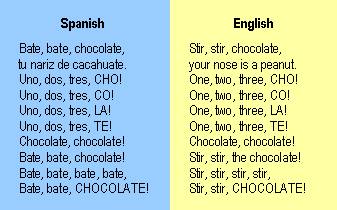
Today, Mexican children often drink hot chocolate with breakfast and they’ve even got a little ditty called Chocolate that they sing as their chocolate is being prepared and frothed.

A brew of Mexican hot chocolate is very simple to make using the Mexican chocolate available in many American grocery stores. The chocolate comes in hard disks and is made of cacao nibs, sugar and cinnamon. It is course and gritty before it is melted, rather than smooth like American bars, baking chocolates or chocolate chips. It can be found in the ethnic food section. I prefer the Ibarra brand, but Abuelita is a good substitute.

I grew up drinking Mexican hot chocolate and, for me, nothing can compare to a taza (cup) of the slightly bitter, cinnamon, chocolate treat.

Bate, bate chocolate!

Tidbits on Chocolate:

  1. The Mayas and Aztecs made their cacao drinks frothy by repeatedly pouring the liquid from high, back and forth between vessels. Then, the Spanish modeled a molinillo after indigenous whisks to make their chocalatl frothy. Molinillos are available in most Mexican markets and online (see images below).
  2. Some lore indicates that cacao has aphrodisiac effects and that Motecuhzoma Xocoyotzin (“Montezuma”) drank fifty mugs of chocolate a day, especially before entering his harem.

View recipe for Chocolate: Mexican Hot Chocolate

Print & If you liked this post, please share:
  • Print
  • email
  • Facebook
  • Twitter
  • StumbleUpon
  • Digg
  • del.icio.us
  • Google Bookmarks

Quinoa: African Peanut Quinoa Soup

African Quinoa Peanut Soup_ForkFingersChopsticks.com

If you haven’t tried quinoa yet, this toothsome African peanut soup will surely lure you in. It has a slew of nutritious vegetables in a creamy, peppery broth with lovely bits of crunchy quinoa. The soup makes the rotation in my comfort food repertoire several times during the cold-weather season because it is both healthy and decadent.

Although quinoa is native to the South American Andes region (read about its origins), it is now cultivated around the world – from Colorado to the Himalayas to Ethiopia and other areas of East Africa. This dish has a definite African influence – the use of nuts to thicken the stew, and staple ingredients such as sweet potatoes and okra. Frankly, it’s the peanut-based sauce that makes this dish a stand-out. If you don’t like peanuts, you won’t appreciate this dish. But, for nut fiends, you’re in for a treat.

Yes, I’m one of those people who eats spoonfuls of nut butter just because I can. So, when I came across the original recipe for this soup online at FoodDownUnder.com several years ago (the original recipe is no longer on the site), I knew I had to try it. Over the years, I’ve fine-tuned it:  the recipe below is more aggressive with spices and chiles; it also has more veggies, peanut butter and quinoa; and, the consistency is that of a soup rather than a thick stew.

This recipe doubles easily and has been a hit at parties with vegetarians and meat-eaters. It’s a great way to introduce quinoa into your diet. And, if you’re already eating the “Mother Grain,” its a must-have recipe.

Tidbits on Quinoa:

  1. As quinoa cooks, the pearls of germ separate and form tiny spirals. The cooked grain is tender, with a slight crunchiness from the germ (see spirals in image below).
  2. Colorado, with its high altitude and cold climates, was crucial testing ground for introducing quinoa to the United States in the mid-70s. Don McKinley and Steve Gorad, founded the Quinoa Corporation in Boulder, Colo., and first planted quinoa seeds in their backyards and eventually in plots in the San Luis Valley. However, most quinoa sold in the United States is imported from South America.
  3. A quinoa plant can grow to anywhere from three feet to over ten feet tall. Plant stems can be straight or branched, and seeds can vary in color from white, yellow, gray, light brown, pink, black to red.

View recipe for Quinoa: African Peanut Quinoa Soup

Print & If you liked this post, please share:
  • Print
  • email
  • Facebook
  • Twitter
  • StumbleUpon
  • Digg
  • del.icio.us
  • Google Bookmarks

Quinoa: Cardamom Quinoa Breakfast Porridge

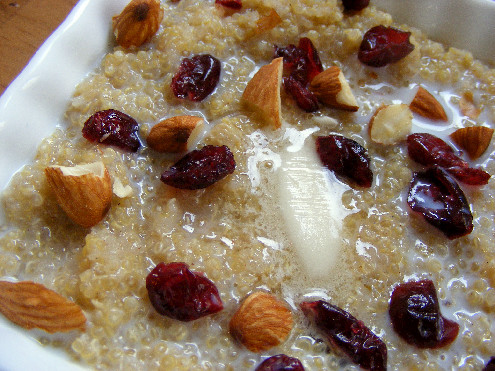
Cardamom Quinoa Porridge_ForkFingersChopsticks.com

Since I started this blog I’ve become a food history nerd. I get excited about sexy stuff like botanical names and species, nutritional makeup, and how an ingredient was cultivated and used in a particular culture. As I learn, I’ve gained a deeper appreciation of food and its long, long journey over time and distance to my plate.

If you’re unfamiliar with quinoa, chew on this . . . Today, quinoa is considered a “superfood” and I’d venture to say it’s on the brink of becoming very mainstream.

Quinoa (pronounced KEEN-wah) dates back more than 5,000 years and was a staple to millions of South American natives. The grain has a texture between millet and couscous, and can easily be substituted for rice or ground into flour. It was an ideal food in the Andes mountain region, where it sustained the altiplano Incas in Peru and Bolivia. It is high in protein and grows well in cold and high altitude areas; locations where maize could not grow.

The Incas considered quinoa to be sacred and referred to it as the “Mother Grain.” It was used in ceremonial practices, as well as consumed daily in porridges and soups. After the Spanish conquest of the Incan Empire in the 1500s, production declined for centuries. The Spaniards destroyed quinoa crops and forbid its cultivation because of its use in non-Christian rituals. Fortunately for us, the grain grew wild and people in remote villages still cultivated it.

Over the last several hundred years it has slowly re-emerged. The demand for quinoa has spread worldwide, particularly in the United States the last 40 years. If you haven’t tried it yet, now is your chance.

Take a lesson from the Incas, quinoa makes for a hearty and comforting breakfast. Like a porridge of oats or other grains, it’s easy to make and even better with cardamom, cinnamon, nuts, and dried or fresh fruit.

Tidbits on Quinoa:

  1. Before cooking quinoa, always rinse the grain well to remove its slightly bitter coating. Rinse as you would rice, until water runs clear.
  2. Quinoa is used and referred to as a grain but technically is a seed. Quinoa seeds expand about four times their size when cooked.
  3. Quinoa is a complete protein because it contains all the essential amino acids, including lysine, which is usually deficient in most grains. It is high in protein (8 grams/1 cup cooked), fiber (5 grams/1 cup) and a good source of iron, zinc, vitamin E, and selenium. It is also good for those eating gluten-free.

View recipe for Quinoa: Cardamom Quinoa Breakfast Porridge

Print & If you liked this post, please share:
  • Print
  • email
  • Facebook
  • Twitter
  • StumbleUpon
  • Digg
  • del.icio.us
  • Google Bookmarks

Quinoa: SAME Cafe’s Golden Sunshine Quinoa Salad

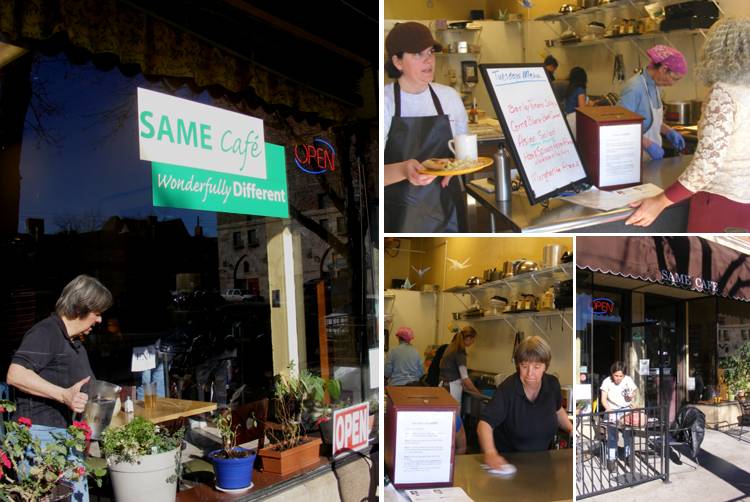
SAME Cafe - Denver Nonprofit_ForkFingersChopsticks.com

This post is my introduction to quinoa. It’s a little out of the ordinary because SAME Café is out of the ordinary . . .

It’s a sunny winter day in Denver, still several minutes before the doors open at SAME Café and there’s a line of people forming outside on this East Colfax sidewalk. The group is a mix of sorts – several in tattered clothes, others in suits, and a few hip folks with piercings and tattoos. They are here for lunch. This, however, is no regular café.

SAME is short for “So All May Eat” and the unusual mode of business here is that people pay what they want. Yeah, that’s right, there’s no set menu price. And, for folks who can’t pay, they can work in exchange. There’s no cash register, just a donation box where people pay what they feel their meal was worth. And, if a person can, leave a little more to help out someone less fortunate.

The nonprofit has been open for three years. In 2009, SAME served over 18,500 meals; since it opened – almost 35,000 meals. It is not a soup kitchen. It’s a communal concept based on dignity with good food at its core. A typical menu looks something like this:  Zuppa Tuscana Soup, Beer Cheese Soup, Chicken Salad, Golden Sunshine Quinoa Salad, Sausage & Mushroom Pizza, Apple Walnut & Bleu Cheese Pizza, and cookies. The menu changes daily and focuses on seasonal ingredients with vegetarian options always offered in the daily menu of soups, salads and pizzas.

This month SAME Café was recognized with the Channel 7 Everyday Hero Award and also an impressive MSN Hometown Heroes Award, an online viewer voting contest connected to their NBC Nightly News segment with Brian Williams (watch the video).

SAME is the brainchild of Brad and Libby Birky who were concerned about the hunger issue here in Denver. The two work full-time at the café, along with one part-time employee and the many volunteers who help with meal preparation, cleaning and numerous miscellaneous tasks.

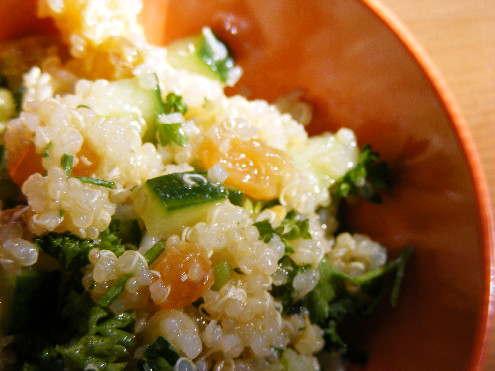
Notably, Libby is also the “Salad Queen” and she generously allowed me to come observe her in action as she prepared the quinoa salad. Her recipe is below with my measurements/ratios (she made a gargantuan bowlful; the recipe is adjusted for a smaller quantity). The salad is refreshing with the citrus-based dressing, fresh parsley and sweet raisins. For those unfamiliar with quinoa salads, this version is tabouleh-esque.

How to Support SAME:

2010 is off to a busy start at SAME. The economic downturn is one reason, as is the season – when the temperatures drop the café sees more people in need of a warm meal. Here’s how you can support their mission:

  • Go in to eat. The food is lovely, particularly the salads and soups!
  • Email them about volunteering
  • Make a donation, financial or in-kind (see their wish list in their weekly blog)
  • Spread the word (share this post with friends and colleagues – see the green icon below). Their meal count helps their funding prospects.

Golden Sunshine Quinoa Salad - Parsley Quinoa - Summer

View recipe for Quinoa: SAME Cafe’s Golden Sunshine Quinoa Salad

Print & If you liked this post, please share:
  • Print
  • email
  • Facebook
  • Twitter
  • StumbleUpon
  • Digg
  • del.icio.us
  • Google Bookmarks

Black Eyed Peas: Vietnamese Sweet Rice & Bean Pudding – Che Dau Trang

Che Dau Trang Coconut Milk Sweet Rice Bean Pudding ForkFingersChopsticks.com

A lot of folks still make resolutions for the New Year. I’m one of them. This year I’ve vowed to be a better me in 2010. I’m calling it 3B: better, bolder and badder. To do it I’ve got to break away from what’s comfortable and lean toward that which makes me apprehensive. You know the things big and small where you silently say to yourself – maybe I shouldn’t, maybe I can’t or I won’t like it. In 2010, I aim to be open to the possibilities.

This recipe for sweet rice and beans is a step in that direction . . . it’s out of the ordinary for my palate but I was pleasantly surprised. When I was researching black eyed peas and the different cultural preparations for these legumes last month, my brows rose with curiosity when I first learned about che dau trang, a Vietnamese sweet rice and bean dish. See, when I eat Vietnamese, my lips smack for spicy lemongrass sauce, salty fish sauce, pho or bun. But since I’m working on my 3B, I resolved to at least try this sweet bean pudding. And, I’m glad I did.

Che (sweet dessert soups or puddings) is believed to have originated in the central region of Vietnam. Che dau (sweet bean dessert) is made in numerous variations, the name changing with the beans that are used – for example, mung (xanh), azuki (do), black (den) and white/black eyed peas (trang).

Sweet bean desserts are a popular snack food because of their hearty contents – beans and sticky rice. Typically, the black eyed pea version is a bit thicker and sets up like a rice pudding. Since they are also sweet and rich, they are definitely decadent enough to be considered a dessert.  It’s usually enjoyed hot or chilled. Although it is also enjoyed in a tall glass over ice, eaten with a long spoon. An interesting cultural note from Anh, my Vietnamese friend’s momma, is that it is tradition to serve che dau trang when celebrating a baby’s one month birthday.

This is not just novelty fare. I was delighted with my first bite. The beans are cooked just right, not too firm or mushy, and are a nice contrast to the creamy coconut rice. I doubt I could eat but a spoonful after a meal, but I would enjoy this again as a tasty breakfast porridge or as the Vietnamese do – as a snack.

Tidbits on Black Eyed Peas

  1. Black eyed peas are believed to originally hail from Africa or India, and subsequently were grown in Asian countries. From there, they were introduced into the West Indies and to the American South around the 1600s.
  2. Black eyed peas provide a good source of calcium, folate, iron, potassium and fiber.

Source: AsiaRecipe.com (see Vietnam Food History), FoodReference.com, Encyclopedia of Food and History

View recipe for Black Eyed Peas: Vietnamese Sweet Rice & Bean Pudding – Che Dau Trang

Print & If you liked this post, please share:
  • Print
  • email
  • Facebook
  • Twitter
  • StumbleUpon
  • Digg
  • del.icio.us
  • Google Bookmarks