Archive for the ‘beverage’ Category

Rice: 5 Ways to Make Horchata- Mexico’s Rice Drink

Thursday, March 25th, 2010

Horchata Rice Drink - Hot Cold -  ForkFingersChopsticks

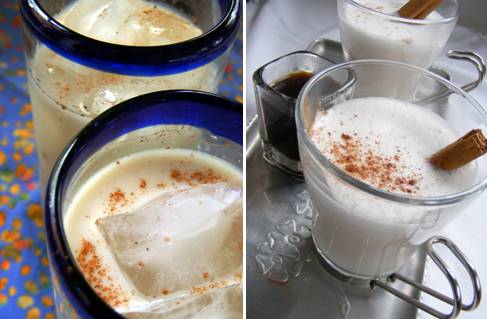
In Mexico and some parts of the U.S., horchata is ubiquitous. The cinnamon-infused rice drink is served cold in huge jars alongside agua de jamaica (hibiscus tea) and other fruit based aguas frescas. This week, we’re also drinking it hot . . .

Despite the unpredictability of spring weather here in Colorado, it’s my favorite of all seasons.

New growth budding on leafless branches. Greener grasses and spring bulbs readying to bloom. Wet snowfalls. Cool weather herbs and greens peeking through in the garden. My first few outings on my bicycle and overestimating how far I could ride. Sore muscles. More snow.

A few days ago we took advantage of 60 degree weather here in Colorado, and cleaned several beds and remnants of seasons since passed. My momma was the willing assistant – helping me carry several tarps full of leaves and turn the compost bin.

That sort of work made us thirsty. Luck (and some pre-planning) was ours, I had three kinds of cold horchata ready to drink. Snap!

As refreshing as it was, we had to fight the urge to drink it all. I still had pictures to take the next day of the “hot” shot – a steamed horchata with a shot of espresso.

A cold blast came through Denver the very next day. Rain quickly turned to snow. And, of course we were out and about in the worst of it. A bit chilled when we got home, we pulled out the horchata again – this time served hot with espresso for momma; steamed and plain for me ( I’m a caffeine wuss).

The hot version, is inspired by Taza de Café, a northwest Denver coffee shop, which serves up horcha-tté, a luscious horchata drink with espresso.

So, horchata is a drink for any season!

Below are 5 ways to make this quintessential Mexican rice drink. Check them out and this song called Horchata by Vampire Weekend, which was released last fall.

Salud!

Tidbits on Horchata:

  1. In Mexico, horchata is typically made from rice and water, although some make creamier versions using milk and/or almonds. There is also an horchata made from ground melon seeds.
  2. Horchata, also called orxata, and this method of making refreshing drinks comes originally from Spain, where they use ground seeds, nuts and grains. There, instead of rice, they use tigernuts, also called chufas.

Source:  The Mexican Gourmet by Maria Dolores Torres Yzabal & Shelton Wiseman

(more…)

Print & If you liked this post, please share:
  • Print
  • email
  • Facebook
  • Twitter
  • StumbleUpon
  • Digg
  • del.icio.us
  • Google Bookmarks

Chocolate: Mexican Hot Chocolate

Wednesday, February 3rd, 2010

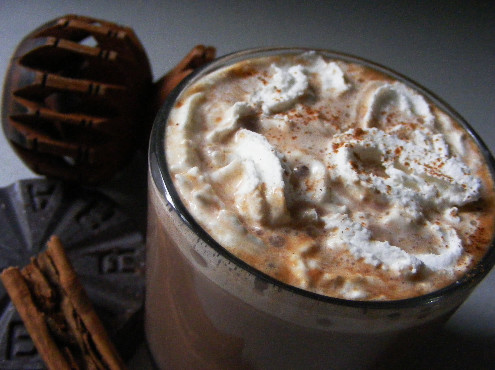
A Cup of Mexican Hot Chocolate_ForkFingersChopsticks.com

Did you know there are chocolate holidays? May 15 is National Chocolate Chip Day, December 16 – National Chocolate Covered Anything Day (I like this one) and February is Chocolate Month. I am a bit of a chocoholic, so one or two recipes with this featured ingredient won’t cut it. Over the next few weeks, you’ll get several sweet and savory chocolate dishes – just in time for the ultimate of chocolate holidays – Valentine’s Day.

First up is Mexican hot chocolate. It journeys back thousands of years to the Mayas, Aztecs and other Central American Indians. In pre-conquest MesoAmerica, cacao trees were cultivated for many purposes, such as currency, ceremonial, and culinary use. Nobles and warriors drank cacahuatl, a bitter, frothy beverage made from ground cacao seeds, water, vanilla and chile.

Then, upon the arrival of the Spanish, cacao beans were used to make chocalatl, the precursor to today’s sweet hot chocolate. Cacao beans were ground with sugar and other spices such as cinnamon, cloves, anise, and almonds to create a paste that was hardened into tablets. The tablets were then mixed with hot water and corn broth, and made frothy. This sweet version, when taken back to Spain, grew in popularity and eventually spread throughout Europe.

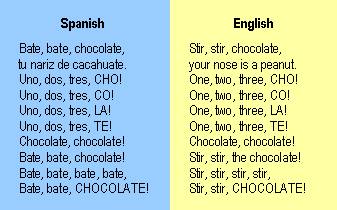
Spanish Children's Rhyme - Chocolate

Today, Mexican children often drink hot chocolate with breakfast and they’ve even got a little ditty called Chocolate that they sing as their chocolate is being prepared and frothed.

A brew of Mexican hot chocolate is very simple to make using the Mexican chocolate available in many American grocery stores. The chocolate comes in hard disks and is made of cacao nibs, sugar and cinnamon. It is course and gritty before it is melted, rather than smooth like American bars, baking chocolates or chocolate chips. It can be found in the ethnic food section. I prefer the Ibarra brand, but Abuelita is a good substitute.

I grew up drinking Mexican hot chocolate and, for me, nothing can compare to a taza (cup) of the slightly bitter, cinnamon, chocolate treat.

Bate, bate chocolate!

Tidbits on Chocolate:

  1. The Mayas and Aztecs made their cacao drinks frothy by repeatedly pouring the liquid from high, back and forth between vessels. Then, the Spanish modeled a molinillo after indigenous whisks to make their chocalatl frothy. Molinillos are available in most Mexican markets and online (see images below).
  2. Some lore indicates that cacao has aphrodisiac effects and that Motecuhzoma Xocoyotzin (“Montezuma”) drank fifty mugs of chocolate a day, especially before entering his harem.

(more…)

Print & If you liked this post, please share:
  • Print
  • email
  • Facebook
  • Twitter
  • StumbleUpon
  • Digg
  • del.icio.us
  • Google Bookmarks

Rum: Swizzle – Bermudian Holiday Drink

Sunday, December 20th, 2009

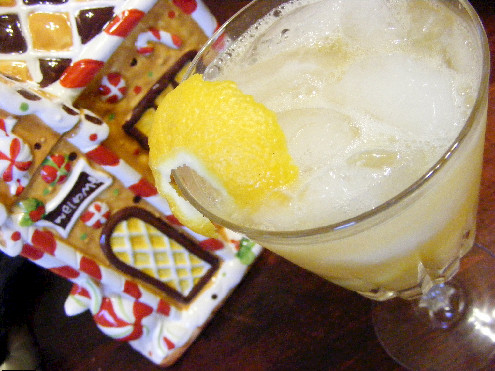
Rum Swizzel_ForkFingersChopsticks.com

According to several sources, swizzle is the National drink of Bermuda. If you’ve had it, you know why – it’s divine. The rum, citrus and ginger make for a refreshing libation.

My friend Ernest, whose family hails from Bermuda, says swizzle is a favorite at Christmas and New Year’s festivities (as well as the Cricket World Cup in the summer months). Frankly, after making this drink, it has already become a staple for me and for entertaining.

This recipe honors the three traditional ingredients of swizzle: dark rum, citrus and sweetener. For rum: use a dark one such as the Bermuda produced Gosling’s Black Seal Rum. The heavier body of darker rums stands firm with the bold flavors of the other ingredients. For citrus:  lime, pineapple and orange juice make a slightly tart, yet sweet combo.

And, finally, the sweetener that makes this an A+ cocktail . . . my ginger simple syrup. Although most recipes (including one from the legendary Swizzle Inn in Bermuda) use falernum, a simple syrup infused with almond, ginger and cloves, I could not locate it and knew most of you would have the same problem. So, I improvised and made my own simple syrup that highlighted the ginger and also imparts a nice molasses flavor. It’s good! Next time, I might add a few cloves.

This holiday season I’m glee with my Bermudian Swizzle. Now, if I could just score some cassava pie.

Tidbits on Rum

  1. The climate of the Caribbean is ideal for growing sugar cane and the region has become the epicenter of the world’s rum production with every major island producing signature rums.
  2. When spirits such as rum are removed from breathable barrels, where they mature, and are put into bottles, the rum no longer ages. A bottle of seven-year-old rum purchased five years ago is still considered seven years old.

Sources:  Tastings.com; Encyclopedia of Food and Culture

(more…)

Print & If you liked this post, please share:
  • Print
  • email
  • Facebook
  • Twitter
  • StumbleUpon
  • Digg
  • del.icio.us
  • Google Bookmarks

Rum: Coquito – Puerto Rican Holiday Drink

Thursday, December 17th, 2009

Coquito Holiday Drink_ForkFingersChopsticks.com

For the holidays we’re mixing things up around here. Literally! We’re not “cooking” so much as we’re getting our holiday groove on, imbibing on one of the top selling spirits in the world . . . rum. First up is coquito. A deliciously creamy coconut elixir steeped in spices:  cinnamon, cloves, nutmeg and vanilla. Coquito is standard during the Christmas season in Puerto Rican households, along with pasteles (savory pastries stuffed with meat), pernil (roasted pork shoulder), arroz con gandules (rice with pigeon peas), and tostones (fried plantains).

Much like eggnog, coquito is a rich holiday drink meant for sipping and savoring. A little goes a long way, especially because it’s loaded with several tasty ingredients like coconut milk and sweetened condensed milk. And, it contains a good dose of rum.

As customary with all things scrumptious, there are a plethora of ways to make coquito. Recipes are tweaked from generation to generation and person to person for a signature twist. More traditional versions require cracking coconuts and fresh eggs. My recipe, however, is much simpler using canned coconut milk and nixing the eggs (no need to drink raw eggs or deal with a double boiler). I’ve also added almond extract for another bold dimension.

Although there is talk of a coquito throwdown in these parts next year, my hermanas Puerto Rican and Boriqueñas were kind enough to let me in on a few tips:  1) cutting the eggs out is not sacrilege and 2) using Coco Lopez® cream of coconut makes for a much sweeter drink. Note, I’ve had plenty of versions of coquito that I found both too rich and sweet, so I use regular coconut milk instead of Coco Lopez®.

This coquito tastes like a tropical Christmas. If you can’t be on the island, taste it. For optimum flavor, make note to make this at least a day ahead.

Salud!

Tidbits on Rum:

  1. Rum is derived from sugarcane. Essentially, when sugarcane is crushed, the juice that is extracted is boiled and separates into crystallized sugar and a remnant sugary liquid known as molasses. The molasses is further distilled and aged to make rum.
  2. Fermenting and distilling sugarcane to make beverages dates back thousands of years to China, Egypt, India, Syria, Southeast Asia and the South Pacific.
  3. About 80 percent of the rum consumed in the United States is from Puerto Rico.
  4. Rums come in light (silver) and dark (gold). Most light rums are produced in Puerto Rico, while the darker versions come from Jamaica.

Sources:  The Oxford Encyclopedia of Food and Drink in America; The Encyclopedia of Food and Culture.

(more…)

Print & If you liked this post, please share:
  • Print
  • email
  • Facebook
  • Twitter
  • StumbleUpon
  • Digg
  • del.icio.us
  • Google Bookmarks