Archive for the ‘By Ingredient’ Category

Rice: Mexican Rice – Arroz a la Mexicana

Thursday, March 18th, 2010
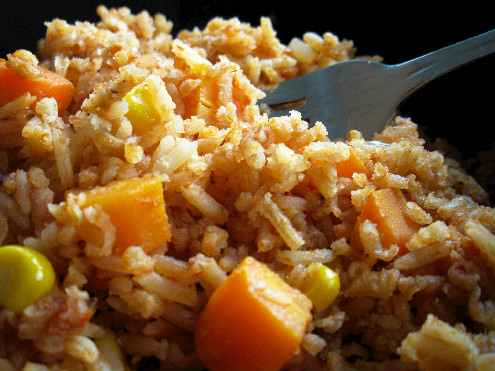
Mexican Rice-ForkFingersChopsticks.com

Mexican rice, also called arroz a la Mexicana or arroz rojo, is a requisite when it comes to Mexican food.

In the States, it is a standard side served along with beans. In Mexico, it is one of the most popular sopas secas (dry soups), in a multi-course meal, typically served before the main course.

In case you’re confused, Mexican rice is different than Spanish rice, although some people use the names interchangeably. The Mexican version gets its reddish hue from tomatoes, while Spanish rice generally uses saffron.

Mexican rice was one of the first dishes I learned to cook that required a little skill in the kitchen – sautéing, boiling and steaming. Sounds tricky, but it really just requires keeping a watchful eye on the pot during the sauté.

I’ve been making rice for eons and only recently realized that the technique I learned from my momma, and she from her abuela, was considered a pilaf. In pilafs, the rice/grain is browned in fat before it is simmered in a flavored broth. This cooking process creates fluffy, flavorful rice that’s moist. It also gives it a faint smoky taste from browning.

As you’ll see from the ingredient list and the photos, I add vegetables to my rice. It’s the way my family does it and it’s also the way many in Mexico make it – cocineros add carrots, peas, zucchini and/or fresh whole chiles for flavor. However, if you add peas, promise not to use the canned stuff! Ewww.

Most of the time, I eat this rice with black beans, lots of fresh pico de gallo, and slices of avocado atop. (The pre-cursor to Chipotle’s® bowl.) Others usually eat it as a side dish. Try it with rajas and grilled chicken, caldo de res, mole poblano, and Mexican zucchini – calabacitas con elote.

Tidbits on Rice:

  1. Rice was introduced to Mexico via the Spanish during colonization via the Spanish trade route from Manila in the Philippines to Acapulco in Mexico. In Mexico, the route is referred to as the Nao de China.
  2. The length of rice grains should be considered for your desired end result. Long grain rice is fluffy and has separate individual grains after cooking, while medium grain rice clings together a bit more but remains a bit more tender and moist. Short grain rice tends to stick together and is best for things like rice puddings.

Sources:  Encyclopedia of Food & Culture; The Art of Mexican Cooking by Diana Kennedy

(more…)

Print & If you liked this post, please share:
  • Print
  • email
  • Facebook
  • Twitter
  • StumbleUpon
  • Digg
  • del.icio.us
  • Google Bookmarks

Rice: Five Spice Brown Fried Rice

Thursday, March 11th, 2010

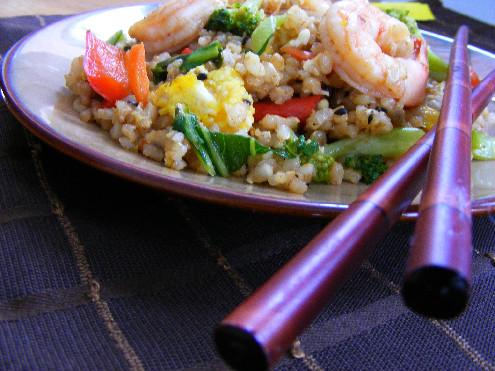
Brown Fried Rice - ForkFingersChopsticks.com

It’s ironic but my favorite five spice mix has six ingredients:  Chinese cinnamon, Chinese #1 ginger, star anise, ground fennel, cloves and black pepper.

A quick search online indicates that it’s not all that uncommon and there are mixes aptly named “seven spice.” Supposedly, it’s not so much the number of spices used that’s of import but encompassing all five flavors – sweet, sour, bitter, pungent and salty.

Regardless, the spice mix is what turns this vegetable-laden brown rice dish into a Chinese-inspired main course that’s quick and easy. In China, stir-frys were eaten out of practicality – meat was scarce but rice and vegetables were more plentiful. Stir-frying also conserved fuel by cooking food quickly.

Even though I write this food blog – and put more time into cooking than some – I take advantage of some practical approaches to cooking. For instance, I make one big batch of rice for the week. We’re not huge pasta or bread eaters in our house, so our starchy carb is rice. It’s usually eaten with a lot of soups and beans.

Over the last few months though, I’ve been making fried rice out of leftover brown rice. It’s a go to recipe when I want something substantial without a whole lot of effort. Each time I’ve made it’s been a little of this and that – how I generally cook. I provided measurements just as a guide but hope you make it your own. So, use whatever vegetables you have in the crisper, change out/omit the meat source and even use white rice.

And, one more thing – this is a healthy meal and a good way to eat more vegetables and fiber – despite the word “fried.”

Tidbits on Rice:

  1. Rice feeds more than half of the world’s population.
  2. Asia, Latin America and Africa comprise the world’s major rice growing regions. Notably, most rice is consumed within 10 miles of where it is produced.

(more…)

Print & If you liked this post, please share:
  • Print
  • email
  • Facebook
  • Twitter
  • StumbleUpon
  • Digg
  • del.icio.us
  • Google Bookmarks

Rice: Perfect Brown Rice at High Altitude

Tuesday, March 9th, 2010

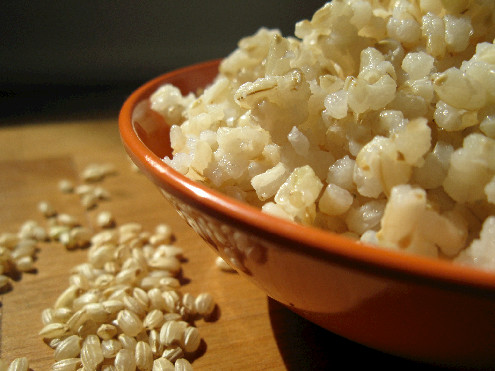
Perfect Brown Rice with Grain - ForkFingersChopsticks.com

It’s back to basics with brown rice.

Nutritionally brown rice is better for you than its white counterpart –  it’s higher in fiber, vitamins and minerals. And, I think it tastes better – it’s chewier and nuttier. The tradeoff, however, is that it has a much longer cooking time and is more perishable.

Generally, I’m a patient person. But, making a good pot of brown rice used to give me a fit. Despite the fact that I love cooking gadgets, I refuse to buy a rice cooker, so I do it old school – in a pot. That meant cooking brown rice for an hour plus at high altitude with a lot of guesswork and not so good results.

That was, until I learned the trick.

After one of my not-so-successful attempts, I came across a recipe for Perfect Brown Rice on Pinch My Salt, which adopted an unusual cooking technique from Saveur magazine. Basically, the trick is this:  boil the rice in a lot of water, drain it off and return it to the pot to steam. So simple, but it works.

I adapted the technique slightly for high altitude – using 6 cups of water per 1 cup rice and also boiling the rice longer. (Saveur used 12 cups water/30 minute boil, Pinch My Salt 4 cups/30 minute boil.) At high altitude it has to cook a bit longer and the water/rice ratio needs increasing. However, the 6 to 1 ratio can be used wherever you might be located.

So far I’ve used this method to cook short grain brown rice, long grain brown rice and brown basmati and they’ve all come out perfect. (The photos are of short grain brown rice.) Give it a go!

Tidbits about Brown Rice:

  1. Rice Layers: A rice grain is comprised of several layers. In brown rice, only the outer husk is removed. However, in white rice the grains are milled to further remove the bran and germ.
  2. Class:  Today brown rice costs more than white rice but in certain parts of the world, particularly in parts of Asia, brown rice was less preferable and associated with poverty.
  3. Nutrition: Brown rice is one of the top nutritious foods on the market because it provides high levels of fiber, complex carbohydrates, certain B vitamins, vitamin E, lysine, calcium, iron, and phosphorus. It’s also touted as good for weight-loss because it has no cholesterol, a miniscule amount of fat, and only an estimated 160 calories per cooked cup.
  4. Storage: Brown rice becomes rancid more quickly than white rice, therefore it should be refrigerated. Sources vary on how quickly it should be used, typically between one and six months.

Sources:  Britannica.com; AsiaRice.org; Rice as a Food, Encyclopedia of Food and Culture.

(more…)

Print & If you liked this post, please share:
  • Print
  • email
  • Facebook
  • Twitter
  • StumbleUpon
  • Digg
  • del.icio.us
  • Google Bookmarks

Lentils: Lentil & Plantain Salad – Ensalada de Lentejas Y Platanos

Tuesday, March 2nd, 2010

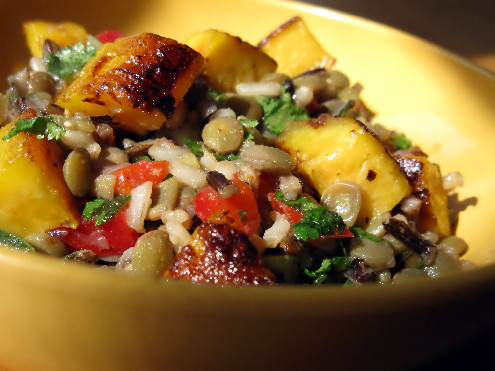
Ensalada Lentejas con Platanos - Lentil Plantain_ForkFingersChopsticks.com

Apparently, lentils and bananas are combined more commonly than we think.

I came upon a Banana-Lentil Salad recipe while browsing Nuevo Latino: Recipes that Celebrate the New Latin-American Cuisine by Douglas Rodriguez, a James Beard award-winning chef. His salad trails back to the Spanish Canary Islands.

In Mexico, as well as in other Latin American and Caribbean countries, lentejas y platanos (lentils and plantains) are frequently eaten as a soup usually stewed with pork. And, in places like Puebla, Mexico, pineapple is also added to the mix, according to The Art of Mexican Cooking by renowned cookbook author Diana Kennedy, who links the savory/sweet combo to Moorish Spain. The combination can also be traced to some African recipes.

This salad recipe, however, is my version of lentejas and platanos. It’s loosely inspired by Rodriguez and traditional lentejas recipes.

If you’re leary about the lentil/plantain combo – have the salad without the plantains, it’s still plenty flavorful and healthy. However, you’re on notice that it’s those platanos fritos (fried plantains) that makes this salad special.

The caramelized plantains have sweet, tender insides that are also a tad bit tangy and a perfect contrast to the crunchiness of peppers, onion and celery, and the nuttiness of wild rice and lentils.

It’s an unusual twist that’s not so unusual.

Tidbits on Lentils:

  1. Before cooking lentils, be sure to sort the legumes to remove any debris such as dirt and stones. Then rinse well in a colander and drain. It is not necessary to pre-soak lentils before cooking.
  2. Store unused lentils in an airtight container in a cool, dry location for up to one year.
  3. Lentils are high in soluble fiber and recommended for people with diabetes and cholestoral problems.

(more…)

Print & If you liked this post, please share:
  • Print
  • email
  • Facebook
  • Twitter
  • StumbleUpon
  • Digg
  • del.icio.us
  • Google Bookmarks

Lentils: Comforting Red Lentil Soup

Wednesday, February 24th, 2010

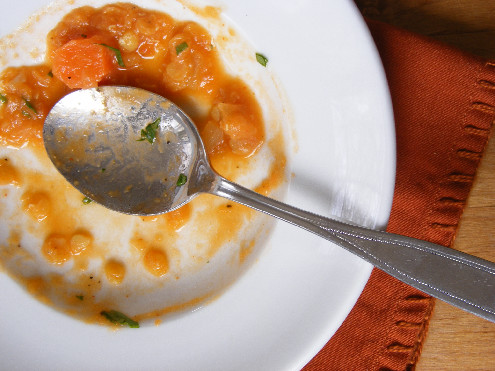
Red Lentil Soup_ForkFingersChopsticks.com

This red lentil soup is comfort food.

It takes the edge off a cold, winter day and satiates my panza (belly).

It’s a souped-up tomato soup – made hearty with red lentils and flavorful with my favorite warming spices:  ginger, cumin and chile.  Several Ethiopian red lentil dishes are similar; this one is more simple.

Last month, I made a jumbo batch for a New Year’s snowshoe group outing. It was a crowd pleaser. After trekking steep hills in gusty winds at 11,000 ft., we huddled near a fire pit warming cold fingers and toes. And, we grubbed! Hot chocolate, hot ginger tea, home-made sweets, grilled spicy sausage on sticks and, yes, red lentil soup. It was a wonderful way to start the New Year – outdoors, warm and belly full.

Red lentils cook faster than other lentils because they are hulled. Although they are referred to as red, they are actually a salmon pink hue. When cooked, the discs turn golden and are delicate, which makes them well-suited for purées or soups.

This lentil soup is a filling main course especially when served with crusty bread. It’s also a nutritious side dish with a sandwich (or sausage on a stick).

Tidbits on Lentils:

  1. Lentils’ botanical name Lens culinaris means cooking lens, a reference to its convex shape.
  2. Up until the later part of the last century, lentils and other beans were generally stigmatized as peasant food – they were staples to those who could not afford meat. However, in places like Egypt, there were aficionados who were particularly fond of red lentils. In India, where vegetarianism was prominent, lentils were also integral to diet.

Source:  Beans: A History by Ken Albala

(more…)

Print & If you liked this post, please share:
  • Print
  • email
  • Facebook
  • Twitter
  • StumbleUpon
  • Digg
  • del.icio.us
  • Google Bookmarks

Lentils: Easy Dal – Indian Lentil Stew

Wednesday, February 17th, 2010

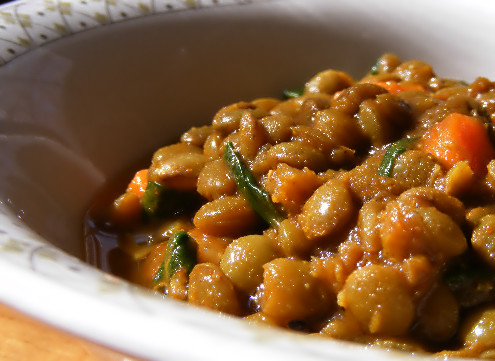
Easy Dal_ForkFingersChopsticks.com

Growing up Catholic, lentils were standard in my house every Lenten season. Now, as an adult, I eat them year-round but more frequently during the colder months in hearty soups and other comforting dishes. Although some of you may be scrunching your nose about now, don’t. They make for good eating. Yes, lentils prepared inadequately can be boring and flavorless – perhaps why they get associated with deprivation. But, spiced right, they are oh so scrumptious and uber healthy.

For inspiration on cooking lentils, I look toward India, Pakistan and other countries in the Indian subcontinent, where lentils are integral to diet and dal.

Simply speaking, a dal (also spelled dahl, daal or daahl depending on the specific region) is a stew made from legumes such as lentils and is typically seasoned with turmeric, ginger, and other spices. It is enjoyed with roti (flatbread), fragrant basmati rice, and vegetables.

Traditional dal requires making lentils from scratch. Even though they cook relatively fast compared to other legumes, we’re keeping it simple. Pre-made lentils and a handful of other ingredients (that are likely in your pantry) are all that is needed. This easy recipe is a healthy go-to-meal for those nights when you want something home-made but don’t want to spend hours in the kitchen. It takes about 15 minutes to prepare.

Try this dish as an alternative for a Lenten Friday meal or, if you’re like me, anytime.

Tidbits on Lentils:

  1. Lentils are believed to have originated from Eastern Turkey and Northern Syria and are thought to be one of the first crops cultivated by man. They have been a food source for over 8000 years, although wild lentils, dating back 11,000 years, have also been found in a Greek cave.
  2. There are at least 50 cultivated varieties of lentils that come in various forms (split versus whole), various sizes, and an array of colors including yellow, red, green, brown and black.
  3. Lentils are often considered a good substitute for meat and have gained popularity as a Lenten food. These legumes are a good source of lean protein. They are a complete protein paired with grains, nuts, seeds, eggs and dairy products.

(more…)

Print & If you liked this post, please share:
  • Print
  • email
  • Facebook
  • Twitter
  • StumbleUpon
  • Digg
  • del.icio.us
  • Google Bookmarks

Chocolate: Red Velvet Cacao Nib Cupcakes

Friday, February 12th, 2010

Red Velvet Cupcake with Cacao Nibs_ForkFingersChopsticks.com

Red velvet cake is a Southern classic. It is neither a traditional vanilla cake nor chocolate cake. Yet, cocoa powder is an essential ingredient and the reason why it’s included with my chocolate recipes. That and it’s perfectly gorgeous for Valentine’s Day.

As the name suggests, the cake has a velvety tender texture that is moist and brilliantly red with a subtle chocolate tone. When topped generously with a cream cheese frosting, it makes for a striking contrast.

Instead of a full-on cake, I made cupcakes. They are less formal than a three-layered cake and perfect for sharing with family and friends. Cupcakes were also conducive to cacao nibs – my twist for oomphing up the chocolate factor. It’s not completely traditional but it’s fun.

As for the origins of red velvet cake, the exact history is a bit head-spinning but alluring for foodiephiles . . . Some researchers believe the pinkish-hued chemical reaction that occurs when cocoa powder is mixed with vinegar and/or buttermilk made a precursor cake that was eventually augmented with food coloring. Other researchers point to the rations of World War II, when beets were used to brighten the color of cakes. And, there’s even some food lore involving the Waldorf Astoria and a woman in the 1920s who was billed an exhorbitant amount when she requested their recipe. Apparently, furious, she copied the recipe and distributed it generously. And, still others suggest the cake’s origins are in Canada tied to Eaton’s department store.

Despite all that, I was first introduced to red velvet cake by my husband’s Aunt Gloria. What I remember most about her cake was how lovely it looked sliced and the hint of chocolate and tangy frosting with each bite. She’d make her cake, freeze it and bring it on the plane to Colorado. Now, that’s love. The recipe below is adapted from Aunt Gloria’s family recipe.

Show love this Valentine’s Day . . . Eat chocolate in its many forms.

Tidbits on Chocolate:

  1. Chocolate has an American annual per capita consumption of around 14 pounds per person.
  2. Although not true legumes, cacao seeds are frequently called “beans.”
  3. Typically in the United States, “cacao” is used to refer to the tree and its dried seeds prior to further processing.  “Cocoa” refers to the partially defatted, roasted, and ground cacao seeds. “Chocolate” is generally used to refer to a food prepared from roasted cacao seeds. “Cacao nibs” are unsweetened raw pieces of cacao beans, they are crunchy bits that taste slightly nutty with notes of bitter chocolate.

(more…)

Print & If you liked this post, please share:
  • Print
  • email
  • Facebook
  • Twitter
  • StumbleUpon
  • Digg
  • del.icio.us
  • Google Bookmarks

Chocolate: Easy Chicken Mole Poblano

Tuesday, February 9th, 2010

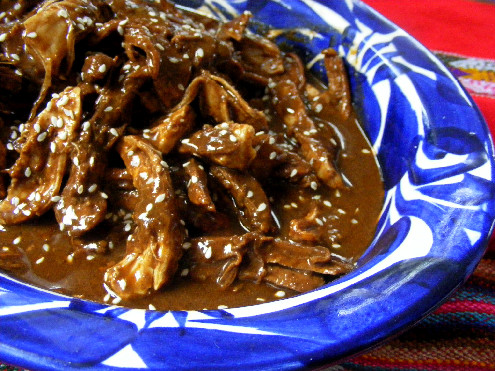
Mole Poblano_ForkFingersChopsticks.com

Hooray for mole (pronounced MOH- lay)!

If you’ve never feasted on mole poblano, you must. It is so beloved it is considered the national dish of Mexico. Mole poblano is a dark, rich, thick, sauce served over chicken or turkey – it’s both bitter and spicy from toasted, ground chiles and also smoothly sumptuous from ground nuts, sesame seeds, spices and bitter chocolate. Yes, chocolate!

Traditionally, when made from scratch, making mole poblano is a labor intensive affair that includes a long, long list of ingredients and a lot of toasting, grinding and frying. For this reason, from-scratch mole is typically reserved for special occasions such as weddings and religious holidays. We, however, have the modern convenience of Dona Maria’s mole paste. So, you can make this dish on a whim.

But, first, feed your mind . . . The word “mole,” in its most general sense refers to a sauce and it’s not always thick or dark; it can be also be green, red, yellow and black. In Mexico, the states best known for moles are typically Puebla and Oaxaca. Fortunately, I’ve eaten mole in both states. Oaxaca, the Land of the Seven Moles, was my favorite.

Mole poblano hails from the mountainous region of Puebla, Mexico and its exact origin is uncertain. The ingredients and cooking techniques used to make this dish are linked to both the Old and New World. While chiles, tomatoes, peanuts and chocolate are native to Mexico’s pre-Spanish cookery (read about the origin of chocolate); the Spanish introduced several Asian spices they obtained from spice-route commerce including sesame seeds, cumin, cinnamon, anise and black pepper.

Regardless, the somewhat unusual blend of chiles, spices and chocolate, makes for a luxurious savory sauce for a special occasion or not. Note:  this dish freezes well and leftover sauce can be used to make enchiladas, as a filling for tamales, over rice and beans, or whatever tickles your tastebuds. Let me know if you have another way you modify mole paste or how you use leftover mole sauce.

Tidbits on Chocolate:

  1. Chocolate has long been considered an aphrodisiac, a quality that made for some controversy among Catholics who consumed it during Lent.
  2. Scientific research is uncertain as to chocolate’s aphrodisiatic properties. However, chocolate has become an essential ingredient in the act of seduction.

(more…)

Print & If you liked this post, please share:
  • Print
  • email
  • Facebook
  • Twitter
  • StumbleUpon
  • Digg
  • del.icio.us
  • Google Bookmarks

Chocolate: Mexican Hot Chocolate

Wednesday, February 3rd, 2010

A Cup of Mexican Hot Chocolate_ForkFingersChopsticks.com

Did you know there are chocolate holidays? May 15 is National Chocolate Chip Day, December 16 – National Chocolate Covered Anything Day (I like this one) and February is Chocolate Month. I am a bit of a chocoholic, so one or two recipes with this featured ingredient won’t cut it. Over the next few weeks, you’ll get several sweet and savory chocolate dishes – just in time for the ultimate of chocolate holidays – Valentine’s Day.

First up is Mexican hot chocolate. It journeys back thousands of years to the Mayas, Aztecs and other Central American Indians. In pre-conquest MesoAmerica, cacao trees were cultivated for many purposes, such as currency, ceremonial, and culinary use. Nobles and warriors drank cacahuatl, a bitter, frothy beverage made from ground cacao seeds, water, vanilla and chile.

Then, upon the arrival of the Spanish, cacao beans were used to make chocalatl, the precursor to today’s sweet hot chocolate. Cacao beans were ground with sugar and other spices such as cinnamon, cloves, anise, and almonds to create a paste that was hardened into tablets. The tablets were then mixed with hot water and corn broth, and made frothy. This sweet version, when taken back to Spain, grew in popularity and eventually spread throughout Europe.

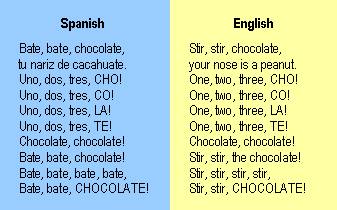
Spanish Children's Rhyme - Chocolate

Today, Mexican children often drink hot chocolate with breakfast and they’ve even got a little ditty called Chocolate that they sing as their chocolate is being prepared and frothed.

A brew of Mexican hot chocolate is very simple to make using the Mexican chocolate available in many American grocery stores. The chocolate comes in hard disks and is made of cacao nibs, sugar and cinnamon. It is course and gritty before it is melted, rather than smooth like American bars, baking chocolates or chocolate chips. It can be found in the ethnic food section. I prefer the Ibarra brand, but Abuelita is a good substitute.

I grew up drinking Mexican hot chocolate and, for me, nothing can compare to a taza (cup) of the slightly bitter, cinnamon, chocolate treat.

Bate, bate chocolate!

Tidbits on Chocolate:

  1. The Mayas and Aztecs made their cacao drinks frothy by repeatedly pouring the liquid from high, back and forth between vessels. Then, the Spanish modeled a molinillo after indigenous whisks to make their chocalatl frothy. Molinillos are available in most Mexican markets and online (see images below).
  2. Some lore indicates that cacao has aphrodisiac effects and that Motecuhzoma Xocoyotzin (“Montezuma”) drank fifty mugs of chocolate a day, especially before entering his harem.

(more…)

Print & If you liked this post, please share:
  • Print
  • email
  • Facebook
  • Twitter
  • StumbleUpon
  • Digg
  • del.icio.us
  • Google Bookmarks