Posts Tagged ‘recipe’

Cornmeal: Green Chile Cheese Grits

Friday, May 28th, 2010

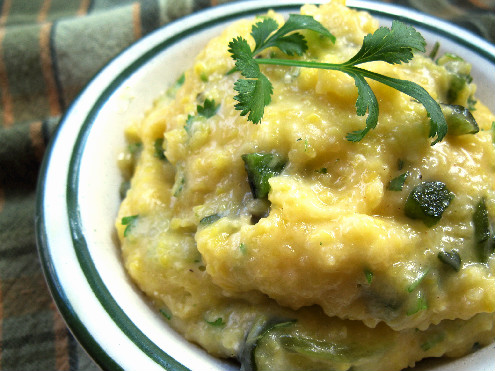
Green Chile Cheese Grits-ForkFingersChopsticks.com

Do you call ground, dried corn “grits” or “polenta?”  You’d be right if you said either one. Yes, polenta, the haute cuisine of the last two decades, is equivalent to good ol’ grits.

Grits v. Polenta

If you’re scratching your head, it’s completely understandable. The labeling is inconsistent and I suspect regional – in the South, I’d reckon you’d find “grits” on store shelves but in northern Italy, you’d see “polenta.”  Here in Denver, I just bought a bag of coarsely-ground, dried yellow cornmeal labeled “polenta (corn grits)” at the natural food store. What gives?

For intellectual purposes, know that one of the primary differences between the two is that grits are usually made with white corn, while polenta is made of yellow.

Some polenta authorities also distinguish the two by the size of the grind, polenta being larger with a nuttier taste. However, both grits and polenta are available in fine, medium and coarse grinds.

To add even more confusion, there’s also the lighter colored “hominy grits.” Early on, the word “hominy” reflected the lye soak process used to loosen the husk and germ, which made for a softer and creamier final dish. Today, “hominy grits” has become a generic term for “corn grits.”

Ugghh. To me it’s all “mush,” like my brain when I try to figure out all this nomenclature.

Green Chile Cheese Grits

Grits are an institution in the South – served with butter and salt, sweetened with milk and sugar, or topped with red-eye gravy, ham, bacon or shrimp.

This recipe for green chile grits is a bit Southern/Soul Food and Mexican – a reflection of my household and history. Corn (maize) was originally domesticated in central Mexico and eventually became a favored crop among Southerners.

These green chile cheese grits are easy to make and much tastier than regular mush. They are delicious for breakfast with eggs or for lunch or dinner as a substitute for potatoes or rice. Enjoy! Leave a comment about your favorite way to eat cornmeal mush, and if you have a preference for “grits” or “polenta.”

Tidbits on Cornmeal:

  1. Southerners hailing from the Charleston area use the word “hominy” to refer to cooked grits and the term “grist” for its uncooked state.
  2. Early Southern pioneers cultivated more corn than cotton.
  3. The smaller the grind of corn, the faster it will cook. Larger grinds (and most polenta recipes) can take up to an hour to cook. The grits/polenta is ready when it’s no longer crunchy.
  4. Stone ground and whole grain cornmeal has more nutrients because it still contains the germ.

Sources:  The Oxford Encyclopedia for Food and Drink in America, Good Old Grits Cookbook by Bill Neal & David Perry.

(more…)

Popcorn: Rosemary-Garlic Popcorn – Snack or Croutons

Friday, May 7th, 2010

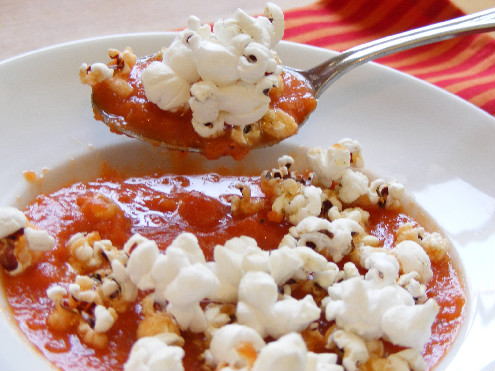
Garlic-Rosemary Popcorn Croutons_ForkFingersChopsticks.com

The modern American palate considers popcorn snack food. However, the other night I watched a flick where the leading lady fed her family popcorn for breakfast. In the movie, she was broke. Nonetheless, it was way out of the box for me. Popcorn cereal?

It may seem kitschy now, but decades ago, popcorn cereal was avant-garde.

According to the history of popcorn cookery, popcorn was on the verge of becoming a staple ingredient in the early 1900s – commonly eaten at every meal. The upper and middle-class are credited with developing this broader recipe repertoire, which was later adopted by the less affluent and farmers.

Besides cereal (cold and hot), popcorn was used to make puddings, bread, popcorn balls, and stuffing.

Popcorn was also used as a replacement for croutons and crackers. The crispy texture was a perfect garnish for soup and salads.

Like most of you, I fall in line with the majority of people who snack on popcorn – usually just salted and buttered. But, with just a little more effort I’ve created an herbed popcorn that can be eaten as regular snack food or as a topper for soup and salad.

The recipe below for rosemary-garlic popcorn is a lovely addition to a hot bowl of tomato soup. Add the popcorn to your dish just before eating, especially with soups.

The recipe is flexible – your favorite herbs and seasoning could be substituted. How about garlic and chive, basil and sun-dried tomato, or chile and lime? At your local spice store there is a plethora of seasoning mixes that could be used and some include powdered cheese – which makes for even tastier popcorn croutons.

If you eat herbed popcorn or use popcorn for something other than a snack, please share in the comments. I’d love to hear from you.

Tidbits on Popcorn:

  1. Popcorn consumption rose in the United States after World War II, when grains were sent to Europe.
  2. The precursor to today’s microwave popcorn evolved from popping the entire cob with kernels in an early model of the  “microwave oven” around 1945.
  3. Popped popcorn is a very profitable business product. It is bought by weight and sold by volume. The aroma of freshly popped popcorn significantly induces sales at movie theatres. Therefore, they regularly pop it.

Source: Popped Culture: A Social History of Popcorn in America by Andrew F. Smith; Corn: Meals & More by Olwen Woodier; Crazy for Corn by Betty Fussell.

(more…)

Popcorn Basics: How to Make Great Popcorn

Friday, April 30th, 2010

Popcorn - Heirloom_ForkFingersChopsticks.com

Normally, I like food with exotic flavors and sauces. But, popcorn, I like simple – popped fresh with a dash of salt and, on occasion, lightly buttered.

After talking with folks here and there about how they eat p-corn, it seems I’m not alone. Most adults, or at least the ones I spoke with, prefer to nosh on popcorn that’s simply salted and buttered. It’s most often eaten while watching flicks.

So this post is about the basics. No fancy toppings or long ingredient list. (My shortest recipe to date.)  Just some guidance on making great popcorn at home.

I do not claim to be an expert. But, we know a bit about popcorn in our house since we make it two to three times per week. Roughly speaking, I (yes, just me) eat about 100 quarts of popped popcorn a year. Note: the average American generally consumes about 44 quarts of per year.

Let me know how you like your popcorn? Or, if you employ any interesting techniques. Before we get to popping, here’s some helpful info:

Why does popcorn pop?

The outer shell of popcorn kernels (the pericarp) is tougher than regular corn and can withstand greater pressure. This special maize “pops” when heated because the moisture inside the kernel swells as it cooks, rapidly expanding to a point where the shell cannot contain the explosion. It bursts, turning it inside out.

Butterfly v. Mushroom?

These terms refer to the “flake” shape. Whether it’s marked “butterfly” or not, it’s the kind found in most grocery stores. Butterfly popcorn is irregular in shape with protruding “wings.”  The mushroom variety is ball-shaped with less distinct wings. The main difference comes down to texture. Popped butterfly popcorn is light and fluffy, with wings that are delicate. Mushroom popcorn is generally preferred for candied and coated popcorn because it is denser and less delicate.

Popcorn Maize - Cob - Kernels - ForkFingersChopsticks

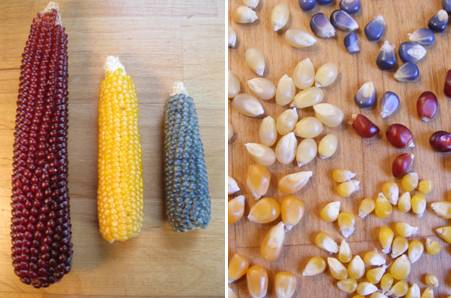
Boulder Popcorn heirloom (left); Popcorn varieties (right, clockwise - top right): Kailey's Kernels, Ryder's Red, Cambria's Cream from Boulder Popcorn, large yellow and white from the grocery store.

Which type:  yellow, white, colored?

Regardless of the color you buy, it’ll pop up some color of white. If you’re shopping for popcorn at a regular grocery store and they have white and yellow kernels, choose white. White popcorn pops lighter and crisper. The yellow has a tougher hull, which makes it much chewier. I also find it sticks in my teeth.

If you have access to other varieties, definitely give them a try. There are several companies selling heirloom popcorn online. In the Denver area, there’s Boulder Popcorn.

Boulder Popcorn sells three heirloom varieties:  red, blue-grey and yellow. The kernels are smaller than what you find in the store and are much lighter and crisp when popped. They carry Ryder’s Red, Kailey’s Kernels (hulless), and Cambria’s Cream (hulless). Note, the hulless varieties still have hulls but they are less distinct, easier on the teeth and to digest. Their popcorn is natural and non-Genetically Modified. This was so good, we ate it plain – no salt or butter. Each variety is unique: the red pops large and fluffy; the blue has a medium, bright white wings with a slight nuttiness; and the cream is smooth and creamy.

What kind of popper?

There’s a lot on the market from hot air poppers to fancy/gimmicky contraptions. However, a no fail method and my preferred equipment is a heavy pot with a lid.

What if I have a lot of duds?

It’s likely the moisture content is low. Don’t throw it out, you can fix it. Put your kernels in a glass jar with about a tablespoon of water. Cover, shake and refrigerate for a day or two. The moisture will absorb into the popcorn and should pop up fluffy. Just make sure the kernels are dry first. Researchers say the moisture content of popcorn kernels should be between 11 to 14 percent.

What kind of fat or oil?

I’ve popped it in olive oil, coconut oil, butter and bacon grease. But, we still prefer canola oil.

What about leftovers?

Heat oven to 200 degrees and reheat on a cookie sheet for about 20 minutes. However, I think the best popcorn is fresh popped.

(more…)

Rice: Puerto Rican Rice with Chicken – Arroz con Pollo

Friday, April 16th, 2010

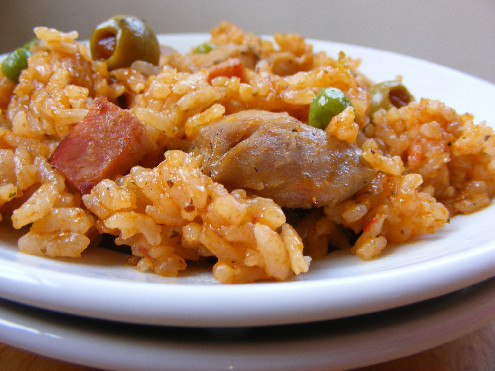
Puerto Rican - Arroz con Pollo - Rice with Chicken - ForkFingersChopsticks.com

A couple of months ago my amiga Kitty and I spent an afternoon cooking. She offered to show me how to make Puerto Rican arroz con pollo, rice with chicken.

I happily assumed the role of sous chef – peeling heads of garlic, chopping veggies, and stirring this and that. Meanwhile, Nivia was my window into the cultural and personal nuances of Puerto Rican cookery .  .  .

For starters, Puerto Rican cuisine employs a spectrum of cooking techniques and ingredients that reflect the island’s diverse inhabitants: the Caribbean native Tainos, Africans, Spanish, and other Europeans.

Three items are signature to the cuisine:  adobo, sofrito and achiote.  Arroz con pollo employs all three. No wonder it’s touted as the most popular chicken dish on the island.

Adobo: In Puerto Rican parlance, adobo is a seasoned salt. A wet adobo made of garlic, olive oil, salt, black pepper, oregano and citrus juice is rubbed on the chicken in this dish and marinated overnight. It’s the secret to moist and flavorful chicken, and it also infuses a layer of flavor to the rice.  Sofrito: The rice is bursting with flavor because of the sofrito, a fresh bouillon of peppers, onions, garlic and herbs. (Read about sofrito and view recipe.) Achiote: Achiote is derived from annato seeds and is used for its subtle flavor and to give the dish a reddish hue. No saffron here, the less expensive achiote is a long-time tradition in Puerto Rican cooking. Achiote can be purchased as a paste, ground or in seed form. It is readily available in Latino markets and spice stores.

After cooking with Kitty, I did some research. The majority of recipes out there are more intuitive rather than specific. For a Puerto Rican arroz con pollo novice, that’s not helpful. I know, I made this dish three times in the last several weeks.

Here’s my final recipe, with a bit more detail – I’ve borrowed techniques I learned from Kitty, other Puerto Rican friends and research. Remember it’s the process that matters, so make certain to read the instructions thoroughly before you begin.

It serves six. You’ll be glad to have leftovers!

One more thing, don’t forget the little bits of crispy, cooked rice at the bottom of the pan are called “pegao.” It’s considered the best part of arroz con pollo by some aficionados.

Tidbits on Rice

  1. Rice was introduced to Puerto Rico by Columbus in his second trip to America in 1493 and has since become a primary food source.
  2. Long grain rice is said to be favored in Puerto Rico, according to some sources. However, medium and short grain rice are heavily favored in dishes like arroz con pollo and arroz con gandules.
  3. Arroz con pollo dates back to the eighth century to Andalusia, when the Moors occupied Spain. It has become a popular rice dish in nearly all of Latin America and the Caribbean, with regional variations, of course.

Sources:  The Oxford Encyclopedia of Food and Drink in America; Puerto Rican Dishes by Berta Cabanillas and Carmen Ginorio.

(more…)

Sofrito – Puerto Rican Fresh Bouillon

Wednesday, April 7th, 2010

Puerto Rican Sofrito - Fresh Bouillon - ForkFingersChopsticks.com

Sofrito is the essence in Puerto Rican dishes like arroz con pollo – the next rice recipe in the queue. It’s also the foundation of flavor for beans, soups and other good eats.

What is sofrito? It’s a blend of fresh vegetables and herbs. You could liken it to fresh bouillon because it can be added to a dish to round it out and give it depth.

The idea to liken this fresh base to a “bouillon” was inspired by Heidi at 101 Cookbooks. She posted a recipe for homemade bouillon a few months ago. Her version had carrots, fennel, and a slew of other veggies and herbs – preserved with salt. When I read her post, I immediately reconceptualized a way to explain the culinary use of sofrito.

This sofrito is Puerto Rican. It is not spicy. But, it is flavorful! The main ingredients include: onion, peppers (bell pepper and aji dulce), garlic, cilantro and recao.

In Puerto Rican cookery, recao is also referred to as culantro. It is an herb typically found in tropical areas like Puerto Rico, the Caribbean and Mexico. It has a mild green flavor that is reminiscent of, but not as strong as cilantro.

Look for it in the fresh herb section of ethnic markets labeled as spirit weed, fit weed, cilantro extranjero, cilantro habanero, or in Asian/Vietnamese markets as ngo gai.  I managed to score some at Rancho Liborio, here in Denver.

If you are a sofrito purist and have access to aji dulce, yours will likely be greener in hue. I used a red pepper, which gave it a reddish tinge.

This fresh bouillon is a great addition to your kitchen staples, especially if you’re big on Latino and Caribbean food. It can be made in large batches and frozen in smaller portions (such as ice cube trays) for convenience. For vegetarians and vegans, it’s a nice alternative to oomph up flavor. And, another huge plus, there’s no salt.

Try it! If you make sofrito and have any interesting uses for it, please leave a comment.

(more…)

Rice: 5 Ways to Make Horchata- Mexico’s Rice Drink

Thursday, March 25th, 2010

Horchata Rice Drink - Hot Cold -  ForkFingersChopsticks

In Mexico and some parts of the U.S., horchata is ubiquitous. The cinnamon-infused rice drink is served cold in huge jars alongside agua de jamaica (hibiscus tea) and other fruit based aguas frescas. This week, we’re also drinking it hot . . .

Despite the unpredictability of spring weather here in Colorado, it’s my favorite of all seasons.

New growth budding on leafless branches. Greener grasses and spring bulbs readying to bloom. Wet snowfalls. Cool weather herbs and greens peeking through in the garden. My first few outings on my bicycle and overestimating how far I could ride. Sore muscles. More snow.

A few days ago we took advantage of 60 degree weather here in Colorado, and cleaned several beds and remnants of seasons since passed. My momma was the willing assistant – helping me carry several tarps full of leaves and turn the compost bin.

That sort of work made us thirsty. Luck (and some pre-planning) was ours, I had three kinds of cold horchata ready to drink. Snap!

As refreshing as it was, we had to fight the urge to drink it all. I still had pictures to take the next day of the “hot” shot – a steamed horchata with a shot of espresso.

A cold blast came through Denver the very next day. Rain quickly turned to snow. And, of course we were out and about in the worst of it. A bit chilled when we got home, we pulled out the horchata again – this time served hot with espresso for momma; steamed and plain for me ( I’m a caffeine wuss).

The hot version, is inspired by Taza de Café, a northwest Denver coffee shop, which serves up horcha-tté, a luscious horchata drink with espresso.

So, horchata is a drink for any season!

Below are 5 ways to make this quintessential Mexican rice drink. Check them out and this song called Horchata by Vampire Weekend, which was released last fall.

Salud!

Tidbits on Horchata:

  1. In Mexico, horchata is typically made from rice and water, although some make creamier versions using milk and/or almonds. There is also an horchata made from ground melon seeds.
  2. Horchata, also called orxata, and this method of making refreshing drinks comes originally from Spain, where they use ground seeds, nuts and grains. There, instead of rice, they use tigernuts, also called chufas.

Source:  The Mexican Gourmet by Maria Dolores Torres Yzabal & Shelton Wiseman

(more…)

Rice: Mexican Rice – Arroz a la Mexicana

Thursday, March 18th, 2010

Mexican Rice-ForkFingersChopsticks.com

Mexican rice, also called arroz a la Mexicana or arroz rojo, is a requisite when it comes to Mexican food.

In the States, it is a standard side served along with beans. In Mexico, it is one of the most popular sopas secas (dry soups), in a multi-course meal, typically served before the main course.

In case you’re confused, Mexican rice is different than Spanish rice, although some people use the names interchangeably. The Mexican version gets its reddish hue from tomatoes, while Spanish rice generally uses saffron.

Mexican rice was one of the first dishes I learned to cook that required a little skill in the kitchen – sautéing, boiling and steaming. Sounds tricky, but it really just requires keeping a watchful eye on the pot during the sauté.

I’ve been making rice for eons and only recently realized that the technique I learned from my momma, and she from her abuela, was considered a pilaf. In pilafs, the rice/grain is browned in fat before it is simmered in a flavored broth. This cooking process creates fluffy, flavorful rice that’s moist. It also gives it a faint smoky taste from browning.

As you’ll see from the ingredient list and the photos, I add vegetables to my rice. It’s the way my family does it and it’s also the way many in Mexico make it – cocineros add carrots, peas, zucchini and/or fresh whole chiles for flavor. However, if you add peas, promise not to use the canned stuff! Ewww.

Most of the time, I eat this rice with black beans, lots of fresh pico de gallo, and slices of avocado atop. (The pre-cursor to Chipotle’s® bowl.) Others usually eat it as a side dish. Try it with rajas and grilled chicken, caldo de res, mole poblano, and Mexican zucchini – calabacitas con elote.

Tidbits on Rice:

  1. Rice was introduced to Mexico via the Spanish during colonization via the Spanish trade route from Manila in the Philippines to Acapulco in Mexico. In Mexico, the route is referred to as the Nao de China.
  2. The length of rice grains should be considered for your desired end result. Long grain rice is fluffy and has separate individual grains after cooking, while medium grain rice clings together a bit more but remains a bit more tender and moist. Short grain rice tends to stick together and is best for things like rice puddings.

Sources:  Encyclopedia of Food & Culture; The Art of Mexican Cooking by Diana Kennedy

(more…)

Rice: Five Spice Brown Fried Rice

Thursday, March 11th, 2010

Brown Fried Rice - ForkFingersChopsticks.com

It’s ironic but my favorite five spice mix has six ingredients:  Chinese cinnamon, Chinese #1 ginger, star anise, ground fennel, cloves and black pepper.

A quick search online indicates that it’s not all that uncommon and there are mixes aptly named “seven spice.” Supposedly, it’s not so much the number of spices used that’s of import but encompassing all five flavors – sweet, sour, bitter, pungent and salty.

Regardless, the spice mix is what turns this vegetable-laden brown rice dish into a Chinese-inspired main course that’s quick and easy. In China, stir-frys were eaten out of practicality – meat was scarce but rice and vegetables were more plentiful. Stir-frying also conserved fuel by cooking food quickly.

Even though I write this food blog – and put more time into cooking than some – I take advantage of some practical approaches to cooking. For instance, I make one big batch of rice for the week. We’re not huge pasta or bread eaters in our house, so our starchy carb is rice. It’s usually eaten with a lot of soups and beans.

Over the last few months though, I’ve been making fried rice out of leftover brown rice. It’s a go to recipe when I want something substantial without a whole lot of effort. Each time I’ve made it’s been a little of this and that – how I generally cook. I provided measurements just as a guide but hope you make it your own. So, use whatever vegetables you have in the crisper, change out/omit the meat source and even use white rice.

And, one more thing – this is a healthy meal and a good way to eat more vegetables and fiber – despite the word “fried.”

Tidbits on Rice:

  1. Rice feeds more than half of the world’s population.
  2. Asia, Latin America and Africa comprise the world’s major rice growing regions. Notably, most rice is consumed within 10 miles of where it is produced.

(more…)

Lentils: Lentil & Plantain Salad – Ensalada de Lentejas Y Platanos

Tuesday, March 2nd, 2010

Ensalada Lentejas con Platanos - Lentil Plantain_ForkFingersChopsticks.com

Apparently, lentils and bananas are combined more commonly than we think.

I came upon a Banana-Lentil Salad recipe while browsing Nuevo Latino: Recipes that Celebrate the New Latin-American Cuisine by Douglas Rodriguez, a James Beard award-winning chef. His salad trails back to the Spanish Canary Islands.

In Mexico, as well as in other Latin American and Caribbean countries, lentejas y platanos (lentils and plantains) are frequently eaten as a soup usually stewed with pork. And, in places like Puebla, Mexico, pineapple is also added to the mix, according to The Art of Mexican Cooking by renowned cookbook author Diana Kennedy, who links the savory/sweet combo to Moorish Spain. The combination can also be traced to some African recipes.

This salad recipe, however, is my version of lentejas and platanos. It’s loosely inspired by Rodriguez and traditional lentejas recipes.

If you’re leary about the lentil/plantain combo – have the salad without the plantains, it’s still plenty flavorful and healthy. However, you’re on notice that it’s those platanos fritos (fried plantains) that makes this salad special.

The caramelized plantains have sweet, tender insides that are also a tad bit tangy and a perfect contrast to the crunchiness of peppers, onion and celery, and the nuttiness of wild rice and lentils.

It’s an unusual twist that’s not so unusual.

Tidbits on Lentils:

  1. Before cooking lentils, be sure to sort the legumes to remove any debris such as dirt and stones. Then rinse well in a colander and drain. It is not necessary to pre-soak lentils before cooking.
  2. Store unused lentils in an airtight container in a cool, dry location for up to one year.
  3. Lentils are high in soluble fiber and recommended for people with diabetes and cholestoral problems.

(more…)