Posts Tagged ‘origin’

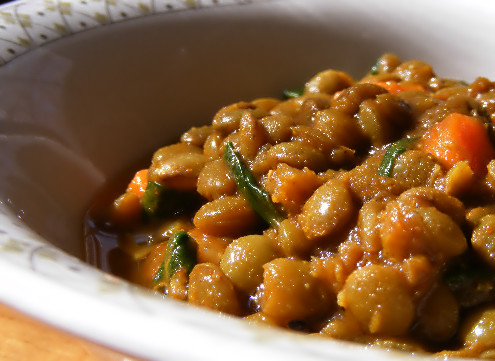
Lentils: Easy Dal – Indian Lentil Stew

Wednesday, February 17th, 2010

Easy Dal_ForkFingersChopsticks.com

Growing up Catholic, lentils were standard in my house every Lenten season. Now, as an adult, I eat them year-round but more frequently during the colder months in hearty soups and other comforting dishes. Although some of you may be scrunching your nose about now, don’t. They make for good eating. Yes, lentils prepared inadequately can be boring and flavorless – perhaps why they get associated with deprivation. But, spiced right, they are oh so scrumptious and uber healthy.

For inspiration on cooking lentils, I look toward India, Pakistan and other countries in the Indian subcontinent, where lentils are integral to diet and dal.

Simply speaking, a dal (also spelled dahl, daal or daahl depending on the specific region) is a stew made from legumes such as lentils and is typically seasoned with turmeric, ginger, and other spices. It is enjoyed with roti (flatbread), fragrant basmati rice, and vegetables.

Traditional dal requires making lentils from scratch. Even though they cook relatively fast compared to other legumes, we’re keeping it simple. Pre-made lentils and a handful of other ingredients (that are likely in your pantry) are all that is needed. This easy recipe is a healthy go-to-meal for those nights when you want something home-made but don’t want to spend hours in the kitchen. It takes about 15 minutes to prepare.

Try this dish as an alternative for a Lenten Friday meal or, if you’re like me, anytime.

Tidbits on Lentils:

  1. Lentils are believed to have originated from Eastern Turkey and Northern Syria and are thought to be one of the first crops cultivated by man. They have been a food source for over 8000 years, although wild lentils, dating back 11,000 years, have also been found in a Greek cave.
  2. There are at least 50 cultivated varieties of lentils that come in various forms (split versus whole), various sizes, and an array of colors including yellow, red, green, brown and black.
  3. Lentils are often considered a good substitute for meat and have gained popularity as a Lenten food. These legumes are a good source of lean protein. They are a complete protein paired with grains, nuts, seeds, eggs and dairy products.

(more…)

Chocolate: Easy Chicken Mole Poblano

Tuesday, February 9th, 2010

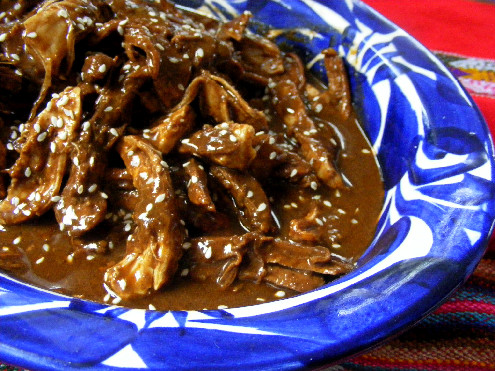
Mole Poblano_ForkFingersChopsticks.com

Hooray for mole (pronounced MOH- lay)!

If you’ve never feasted on mole poblano, you must. It is so beloved it is considered the national dish of Mexico. Mole poblano is a dark, rich, thick, sauce served over chicken or turkey – it’s both bitter and spicy from toasted, ground chiles and also smoothly sumptuous from ground nuts, sesame seeds, spices and bitter chocolate. Yes, chocolate!

Traditionally, when made from scratch, making mole poblano is a labor intensive affair that includes a long, long list of ingredients and a lot of toasting, grinding and frying. For this reason, from-scratch mole is typically reserved for special occasions such as weddings and religious holidays. We, however, have the modern convenience of Dona Maria’s mole paste. So, you can make this dish on a whim.

But, first, feed your mind . . . The word “mole,” in its most general sense refers to a sauce and it’s not always thick or dark; it can be also be green, red, yellow and black. In Mexico, the states best known for moles are typically Puebla and Oaxaca. Fortunately, I’ve eaten mole in both states. Oaxaca, the Land of the Seven Moles, was my favorite.

Mole poblano hails from the mountainous region of Puebla, Mexico and its exact origin is uncertain. The ingredients and cooking techniques used to make this dish are linked to both the Old and New World. While chiles, tomatoes, peanuts and chocolate are native to Mexico’s pre-Spanish cookery (read about the origin of chocolate); the Spanish introduced several Asian spices they obtained from spice-route commerce including sesame seeds, cumin, cinnamon, anise and black pepper.

Regardless, the somewhat unusual blend of chiles, spices and chocolate, makes for a luxurious savory sauce for a special occasion or not. Note:  this dish freezes well and leftover sauce can be used to make enchiladas, as a filling for tamales, over rice and beans, or whatever tickles your tastebuds. Let me know if you have another way you modify mole paste or how you use leftover mole sauce.

Tidbits on Chocolate:

  1. Chocolate has long been considered an aphrodisiac, a quality that made for some controversy among Catholics who consumed it during Lent.
  2. Scientific research is uncertain as to chocolate’s aphrodisiatic properties. However, chocolate has become an essential ingredient in the act of seduction.

(more…)

Chocolate: Mexican Hot Chocolate

Wednesday, February 3rd, 2010

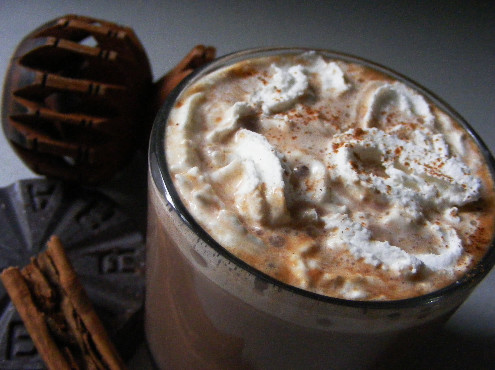
A Cup of Mexican Hot Chocolate_ForkFingersChopsticks.com

Did you know there are chocolate holidays? May 15 is National Chocolate Chip Day, December 16 – National Chocolate Covered Anything Day (I like this one) and February is Chocolate Month. I am a bit of a chocoholic, so one or two recipes with this featured ingredient won’t cut it. Over the next few weeks, you’ll get several sweet and savory chocolate dishes – just in time for the ultimate of chocolate holidays – Valentine’s Day.

First up is Mexican hot chocolate. It journeys back thousands of years to the Mayas, Aztecs and other Central American Indians. In pre-conquest MesoAmerica, cacao trees were cultivated for many purposes, such as currency, ceremonial, and culinary use. Nobles and warriors drank cacahuatl, a bitter, frothy beverage made from ground cacao seeds, water, vanilla and chile.

Then, upon the arrival of the Spanish, cacao beans were used to make chocalatl, the precursor to today’s sweet hot chocolate. Cacao beans were ground with sugar and other spices such as cinnamon, cloves, anise, and almonds to create a paste that was hardened into tablets. The tablets were then mixed with hot water and corn broth, and made frothy. This sweet version, when taken back to Spain, grew in popularity and eventually spread throughout Europe.

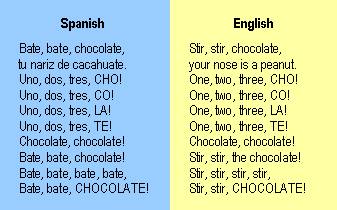
Spanish Children's Rhyme - Chocolate

Today, Mexican children often drink hot chocolate with breakfast and they’ve even got a little ditty called Chocolate that they sing as their chocolate is being prepared and frothed.

A brew of Mexican hot chocolate is very simple to make using the Mexican chocolate available in many American grocery stores. The chocolate comes in hard disks and is made of cacao nibs, sugar and cinnamon. It is course and gritty before it is melted, rather than smooth like American bars, baking chocolates or chocolate chips. It can be found in the ethnic food section. I prefer the Ibarra brand, but Abuelita is a good substitute.

I grew up drinking Mexican hot chocolate and, for me, nothing can compare to a taza (cup) of the slightly bitter, cinnamon, chocolate treat.

Bate, bate chocolate!

Tidbits on Chocolate:

  1. The Mayas and Aztecs made their cacao drinks frothy by repeatedly pouring the liquid from high, back and forth between vessels. Then, the Spanish modeled a molinillo after indigenous whisks to make their chocalatl frothy. Molinillos are available in most Mexican markets and online (see images below).
  2. Some lore indicates that cacao has aphrodisiac effects and that Motecuhzoma Xocoyotzin (”Montezuma”) drank fifty mugs of chocolate a day, especially before entering his harem.

(more…)