Posts Tagged ‘comfort food’

Rice: Puerto Rican Rice with Chicken – Arroz con Pollo

Friday, April 16th, 2010

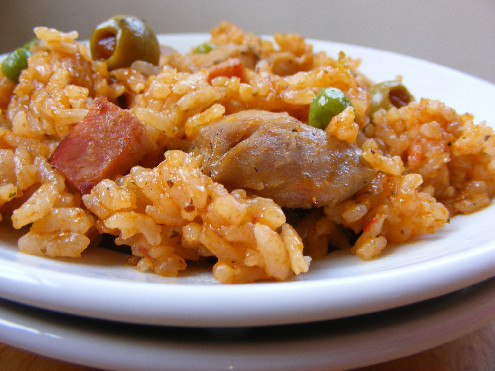
Puerto Rican - Arroz con Pollo - Rice with Chicken - ForkFingersChopsticks.com

A couple of months ago my amiga Kitty and I spent an afternoon cooking. She offered to show me how to make Puerto Rican arroz con pollo, rice with chicken.

I happily assumed the role of sous chef – peeling heads of garlic, chopping veggies, and stirring this and that. Meanwhile, Nivia was my window into the cultural and personal nuances of Puerto Rican cookery .  .  .

For starters, Puerto Rican cuisine employs a spectrum of cooking techniques and ingredients that reflect the island’s diverse inhabitants: the Caribbean native Tainos, Africans, Spanish, and other Europeans.

Three items are signature to the cuisine:  adobo, sofrito and achiote.  Arroz con pollo employs all three. No wonder it’s touted as the most popular chicken dish on the island.

Adobo: In Puerto Rican parlance, adobo is a seasoned salt. A wet adobo made of garlic, olive oil, salt, black pepper, oregano and citrus juice is rubbed on the chicken in this dish and marinated overnight. It’s the secret to moist and flavorful chicken, and it also infuses a layer of flavor to the rice.  Sofrito: The rice is bursting with flavor because of the sofrito, a fresh bouillon of peppers, onions, garlic and herbs. (Read about sofrito and view recipe.) Achiote: Achiote is derived from annato seeds and is used for its subtle flavor and to give the dish a reddish hue. No saffron here, the less expensive achiote is a long-time tradition in Puerto Rican cooking. Achiote can be purchased as a paste, ground or in seed form. It is readily available in Latino markets and spice stores.

After cooking with Kitty, I did some research. The majority of recipes out there are more intuitive rather than specific. For a Puerto Rican arroz con pollo novice, that’s not helpful. I know, I made this dish three times in the last several weeks.

Here’s my final recipe, with a bit more detail – I’ve borrowed techniques I learned from Kitty, other Puerto Rican friends and research. Remember it’s the process that matters, so make certain to read the instructions thoroughly before you begin.

It serves six. You’ll be glad to have leftovers!

One more thing, don’t forget the little bits of crispy, cooked rice at the bottom of the pan are called “pegao.” It’s considered the best part of arroz con pollo by some aficionados.

Tidbits on Rice

  1. Rice was introduced to Puerto Rico by Columbus in his second trip to America in 1493 and has since become a primary food source.
  2. Long grain rice is said to be favored in Puerto Rico, according to some sources. However, medium and short grain rice are heavily favored in dishes like arroz con pollo and arroz con gandules.
  3. Arroz con pollo dates back to the eighth century to Andalusia, when the Moors occupied Spain. It has become a popular rice dish in nearly all of Latin America and the Caribbean, with regional variations, of course.

Sources:  The Oxford Encyclopedia of Food and Drink in America; Puerto Rican Dishes by Berta Cabanillas and Carmen Ginorio.

(more…)

Lentils: Lentil & Plantain Salad – Ensalada de Lentejas Y Platanos

Tuesday, March 2nd, 2010

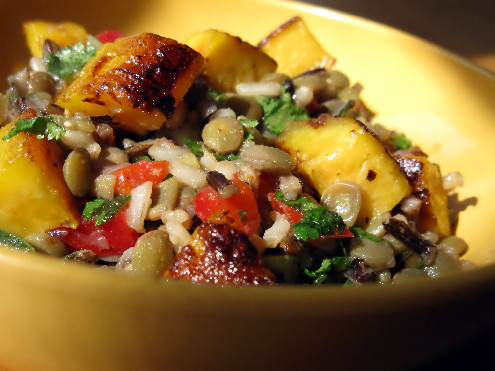
Ensalada Lentejas con Platanos - Lentil Plantain_ForkFingersChopsticks.com

Apparently, lentils and bananas are combined more commonly than we think.

I came upon a Banana-Lentil Salad recipe while browsing Nuevo Latino: Recipes that Celebrate the New Latin-American Cuisine by Douglas Rodriguez, a James Beard award-winning chef. His salad trails back to the Spanish Canary Islands.

In Mexico, as well as in other Latin American and Caribbean countries, lentejas y platanos (lentils and plantains) are frequently eaten as a soup usually stewed with pork. And, in places like Puebla, Mexico, pineapple is also added to the mix, according to The Art of Mexican Cooking by renowned cookbook author Diana Kennedy, who links the savory/sweet combo to Moorish Spain. The combination can also be traced to some African recipes.

This salad recipe, however, is my version of lentejas and platanos. It’s loosely inspired by Rodriguez and traditional lentejas recipes.

If you’re leary about the lentil/plantain combo – have the salad without the plantains, it’s still plenty flavorful and healthy. However, you’re on notice that it’s those platanos fritos (fried plantains) that makes this salad special.

The caramelized plantains have sweet, tender insides that are also a tad bit tangy and a perfect contrast to the crunchiness of peppers, onion and celery, and the nuttiness of wild rice and lentils.

It’s an unusual twist that’s not so unusual.

Tidbits on Lentils:

  1. Before cooking lentils, be sure to sort the legumes to remove any debris such as dirt and stones. Then rinse well in a colander and drain. It is not necessary to pre-soak lentils before cooking.
  2. Store unused lentils in an airtight container in a cool, dry location for up to one year.
  3. Lentils are high in soluble fiber and recommended for people with diabetes and cholestoral problems.

(more…)

Lentils: Comforting Red Lentil Soup

Wednesday, February 24th, 2010

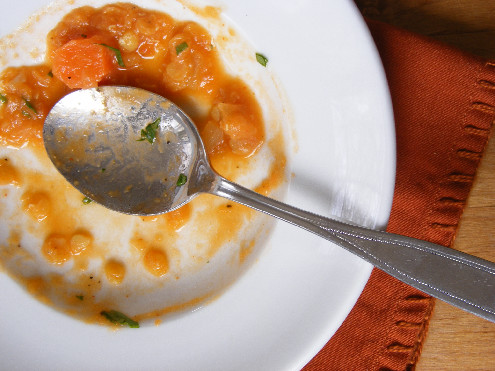
Red Lentil Soup_ForkFingersChopsticks.com

This red lentil soup is comfort food.

It takes the edge off a cold, winter day and satiates my panza (belly).

It’s a souped-up tomato soup – made hearty with red lentils and flavorful with my favorite warming spices:  ginger, cumin and chile.  Several Ethiopian red lentil dishes are similar; this one is more simple.

Last month, I made a jumbo batch for a New Year’s snowshoe group outing. It was a crowd pleaser. After trekking steep hills in gusty winds at 11,000 ft., we huddled near a fire pit warming cold fingers and toes. And, we grubbed! Hot chocolate, hot ginger tea, home-made sweets, grilled spicy sausage on sticks and, yes, red lentil soup. It was a wonderful way to start the New Year – outdoors, warm and belly full.

Red lentils cook faster than other lentils because they are hulled. Although they are referred to as red, they are actually a salmon pink hue. When cooked, the discs turn golden and are delicate, which makes them well-suited for purées or soups.

This lentil soup is a filling main course especially when served with crusty bread. It’s also a nutritious side dish with a sandwich (or sausage on a stick).

Tidbits on Lentils:

  1. Lentils’ botanical name Lens culinaris means cooking lens, a reference to its convex shape.
  2. Up until the later part of the last century, lentils and other beans were generally stigmatized as peasant food – they were staples to those who could not afford meat. However, in places like Egypt, there were aficionados who were particularly fond of red lentils. In India, where vegetarianism was prominent, lentils were also integral to diet.

Source:  Beans: A History by Ken Albala

(more…)

Cabbage: Beef & Cabbage Soup – Caldo de Res

Wednesday, November 18th, 2009

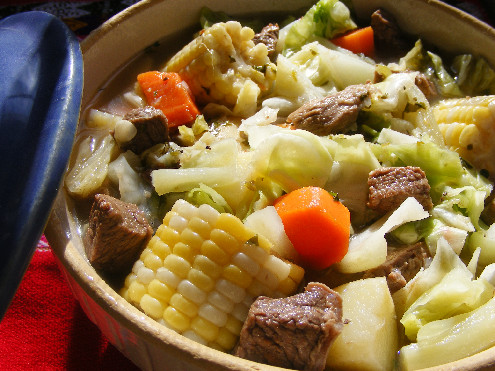
Caldo de Res_ForkFingersChopsticks.com

There are certain dishes that make me nostalgic for childhood.

You know what I’m talking about. A smell or taste that conjures vivid memories of comfort – when life was more simple and childhood dramas were easily soothed by your momma or daddy’s home-made goodies. Like, a bandage and a kiss or hug, but you could eat it. For me, these cabbage recipes have been just that:  the yeasty smell of my mom’s cabbage burgers baking, warming the house and our tummies on a cold day; and, this beef and cabbage soup from my abuela Juarez.

Grandma Juarez is no longer with us. And, I’m sure, I’m not the only one of the 37 grandkids and 46 great-grandchildren who thinks of her when I eat this soup. I remember several a Sunday afternoon visit and her never-empty pot of soup simmering in her little kitchen. Somehow it managed to feed whomever stopped by that day. That, and tortillas de harina (flour tortillas), but that’s another recipe and story.

Caldo de res is comfort soup, perfect for a dreary day or cool night. Tender bites of roast simmered in a beefy broth with winter vegetables – onion, cabbage, potatoes and carrots. It’s a standard in Mexican households and restaurants, although the ingredients may vary slightly – some adding chayote or zucchini.

The recipe below is adapted from my abuela’s recipe (I use a whole head of cabbage and more veggies, and brown the roast first). It also contains her rumoured “secret” ingredient (which, now, is no longer secret), hierba buena, spearmint used in Mexican teas and cooking. It adds a special, fresh dimension to this soothing broth.

For those who’ve never tried caldo de res, if you like Vietnamese pho, which also has a tasty beef broth, you’ll want to try this soup.

Tidbits on Cabbage:

  1. When shopping for cabbage, look for one with a shiny, crisp exterior. It should also feel solid and compact. Avoid buying those that look wilted, brown or dried-out.
  2. Don’t wash cabbage until you are ready to use it. Cabbage can be rinsed after cutting or chopping, drain well.
  3. Boiling cabbage tenderizes the leaves, causing it to release sugar and the characteristic cabbage aroma.

(more…)

Green Chile: Green Pozole

Sunday, October 25th, 2009

Bowl of Green Pozole

For the past several years, I’ve had cooking a good pot of pozole on my list of things to do. If you’ve never had it, you’re missing out. Pozole, also spelled posole or posolli, is a hearty Mexican soup that’s typically made with pork, hominy and chiles, and traditionally eaten around Christmas, although nowadays more regularly. It’s also believed to be a good hangover remedy.

Hangover or not, this soup is gooooodddd. Alone it’s luscious – spicy from the chiles, earthy from the hominy and rich from tender pieces of pork roast. Then when you sprinkle it with dried oregano, fresh lime juice, bits of onion, crispy cabbage and whatever else you flavor, it gets even better.

I’ve looked for inspiration while eating out but have been repeatedly disappointed because I had my heart and taste buds set on a green or clear pozole that was both light and satisfying – something resembling the version I had over 10 years ago with a friend from New Mexico. I prefer the green version over the red for two reasons: red pozole is almost like menudo (another Mexican soup with hominy) and a lot of folks get heavy handed with the red chile, which can get pungent.

So, when my girlfriend Chelby and her husband Don hooked me up with this green chile version, I knew I had to give it a go – the two know good grub (I think it’s a Texas thang) and Don’s version doesn’t have tripe (stomach lining), which I don’t mind eating on a rare occasion but will reserve for my menudo.

Green chiles are a staple ingredient in most Southwestern kitchens. And, early fall is prime time for folks to buy them by the bushel, fresh or roasted. Last week I got my loot:  some Hatch, poblanos, and Anaheim – perfect for this recipe. Note, we’re using fresh, raw chiles for this soup.

Chiles Raw _ Chopped

Hatch chiles hail from Hatch, New Mexico, which has built a reputation as the Chile Capitol of the World among some. For this recipe, Don recommends Hatch chiles, which are more medium to hot on the Scoville Scale. If you can’t find them, substitute with poblano chiles, also called pasillas, which are typically milder. Poblanos are commonly used roasted and stuffed for popular dishes like chile rellenos.

Besides the chiles, the other star ingredient in this dish is hominy, called cacahuazintle in Nahuatl. It’s a natural variety of white corn with large kernels that is about four times the weight of regular corn kernels. Its taste is distinctive, earthy like that of corn in corn tortillas rather than the sweet flavor of corn in corn of the cob.

This recipe is easy to make, despite the length of this post. Enjoy! And, let me know if Don and I’ve converted any of you red pozole lovers.

Tidbits on Green Chile

  1. Green chile is generally a reference to its fresh state and red chiles refer to those that have dried. Generally, as chiles grow, they start off green and turn red or yellow.
  2. Chiles retain their heat level regardless of whether it is cooked, dried or frozen. When using fresh, to reduce the amount of heat, remove the seeds and veins. And, be sure to avoid touching your eyes and other sensitive areas after handling.
  3. “Hatch” chiles are not a variety of chile pepper, but rather a reference to where they are grown, according to the Chile Pepper Institute of the University of New Mexico.

(more…)

Green Tomatoes: Bacon Lettuce & Fried Green Tomato Sandwich

Wednesday, October 14th, 2009

BLFGT Stacked

Fried tomatoes are an oxymoron of sorts, don’t you think? A garden fresh, healthy vegetable battered and fried. Pure indulgence, especially when paired with bacon.

In the South, a regular breakfast phenomenon is bacon and eggs served alongside fried tomatoes (green or red), according to John Egerton in his book Southern Food: At Home, on the Road, in History, which is considered a classic.

Not one for cooking such a “big” breakfast, an alternative was a must. This recipe is a modern twist on the consummate of sandwiches, the BLT, and keeps with Southern tradition by uniting fried green tomatoes and bacon in new form. The sandwich is surprisingly good – crisp and salty bacon, creamy garlic mayo, fresh lettuce (although I used spinach), and slightly tangy, crisp green tomatoes – together they are a mouthful of flavor.

Enjoy! Then go for a walk afterward to compensate.

(more…)

Zucchini: Mexican Succotash – Calabacitas Con Elote

Wednesday, October 7th, 2009

Calabacitas con Elote - H

Zucchini? Yes, zucchini. I’m launching my food blog with this humble, under-appreciated summer squash. Why? Because it’s used way, way too much to make stuff like zucchini bread (although I do make my own version). And, some folks are itching for another way to use all those zucchini that proliferate the gardens and markets this time of year. I know what you’re thinking . . . blah. But, you’re wrong.  It’s all about how it’s prepared.

In this recipe, the zucchini’s fresh, buttery taste is complimented by crisp corn kernels and the sweet juices of tomato and Mexican seasoning. It’s basically a succotash and it’s been served up in my family and other Mexican kitchens for generations.

This is comfort food more often eaten at home rather than in Mexican restaurants, especially those in the States, where the menu favors greasy, fried tacos over vegetables. This dish is just some of the healthy Mexican food I enjoy and it’s quick and easy to make. Of course there are many variations of calabacitas – some omit the corn, others the tomatoes. I like it with both.

Tidbits on Zucchini:

  1. Squash was domesticated as early as 10,000 B.P in central Mexico and Peru, as well as other parts of the Americas. As such, squash was an integral staple in Mexican cuisine, along with corn and beans, according to the Encyclopedia of Food and Culture.
  2. The word calabacita is derived from the Spanish word calabaza, meaning squash; the diminutive “ita” changes the meaning to little squash.
  3. Zucchini is like the tomato – botanically a fruit but thought to be a veggie.

(more…)