Archive for the ‘Parsley’ Category

Parsley: Deviled Eggs with Italian Salsa Verde

Tuesday, July 13th, 2010

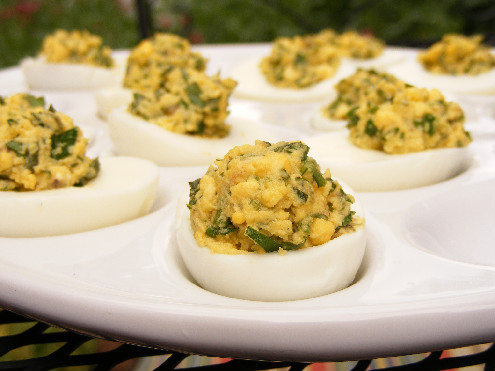
Deviled Eggs Italian Salsa Verde_ForkFingersChopsticks.com

Until last week I was not a deviled egg fan.

I admit to frowning when someone showed up to a party with a plate of ho hum deviled eggs – you know the ones – mashed yolks flavored with too much mayonnaise. Pretty BLAH.

Call me a food snob, but to me, it’s just a notch above bringing cheap hotdogs. (Fear not, I’m gracious and appreciate the thought.)

My attitude changed last week when I made these deviled eggs with Italian salsa verde.

As you know from my last post, Italian green sauce is a fresh herb condiment traditionally paired with boiled eggs – either as an ingredient in the sauce or as a topping for eggs. Thinking about the two, I was inspired to replace the mayo in deviled eggs. The result – deviled eggs that would be a welcome appetizer at a party or summer barbecue.

I was not planning to write this post, but these deviled eggs are so good I had to share. The texture and assertive flavors of the Italian salsa verde make these eggs stand out.

Enjoy!

If you have a particular use for Italian salsa verde, please share. Or, tell us about your favorite deviled eggs.

Tidbits on Deviled Eggs:

  1. Spicy stuffed eggs date back as far as 13th century Andalusia. In a 15th century Italian text, stuffed eggs included raisins, cheese, parsley, marjoram and mint.
  2. In the 18th century, the name “deviled eggs” was termed. “Deviled” is used to connote spicy or fiery, reflecting the seasonings used to flavor. The first recipe for deviled eggs dates back to circa 1786.

Source: FoodTimeline.org.

(more…)

Print & If you liked this post, please share:
  • Print
  • email
  • Facebook
  • Twitter
  • StumbleUpon
  • Digg
  • del.icio.us
  • Google Bookmarks

Parsley: Italian Salsa Verde with Anchovies and Capers

Thursday, July 8th, 2010

Italian Salsa Verde Parsley Anchovies_ForkFingersChopsticks.com

Several things stand out in my memory of the semester I lived in Florence . . .  I remember narrow cobblestone streets. The tranquility of brisk, autumn mornings near the Arno and The Ponte Vecchio, and the quiet occasionally interrupted by buzzing vespas.

I also remember my delight when tasting new Tuscan foods such as Italian salsa verde, green sauce.

In Italy and especially the Tuscan region, Italian salsa verde is paired with steamed vegetables and more traditionally with bollito misto, mixed boiled meats. Made from fresh parsley, anchovies and capers, it certainly awakens the tastebuds.

Salsa verde is a green sauce similar to pesto but uses parsley as the main ingredient. After making it more recently, I would also have to liken it to a fresh herbed version of chimichurri. After all, Italians migrated to Argentina in huge droves in the late 1800s, and the culinary influence is obvious.

As I researched this sauce further, I also found it referenced as “salsa rustica” in the Chianti area.

Most salsa verde recipes include parsley, anchovies, capers, onions, garlic and olive oil. Some also include adding vinegar soaked white bread and/or chopped hard boiled eggs. The addition of either of the latter makes the sauce more substantial and gives it some bulk.

My recipe includes eggs as an optional ingredient.  I make it with and without depending on my mood. My prefernce is still to use the sauce to top boiled eggs rather than include the eggs in the sauce.

Use this green parsley sauce on boiled eggs, steamed green beans, boiled chunks of potatoes, cold meat and as a condiment with canned tuna or to substitute for mayo in deviled eggs. If you don’t care for anchovies, leave them out, it’s still delicious.

Tidbits on Parsley:

  1. Flat leaf or Italian parsley is preferred for many culinary dishes. It has a slightly stronger flavor than curly parsley and holds up better while cooking. If you are making in a white sauce, use the stems rather than the leaves, so that color does not bleed.
  2. According to some alternative medicine remedies, parsley has many healing properties. It can be used in poultices to soothe tired, irritated eyes and also to help heal bruises. The juice can also be used as a natural mosquito repellent and to help relieve the itch and sting of insect bites. Note, however, some people can have allergic side effects.

Sources: The Gale Encyclopedia of Alternative Medicine, The Essential Herb Garden

(more…)

Print & If you liked this post, please share:
  • Print
  • email
  • Facebook
  • Twitter
  • StumbleUpon
  • Digg
  • del.icio.us
  • Google Bookmarks

Parsley: Chimichurri – Argentinean Herb Sauce

Thursday, July 1st, 2010

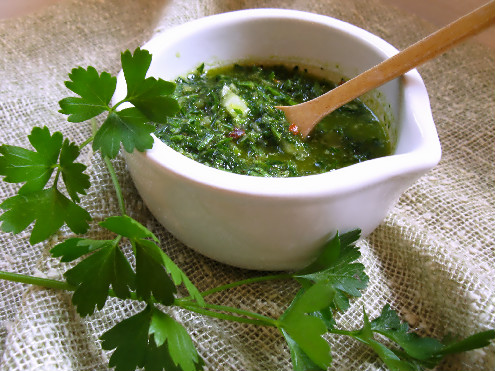
Chimichurri_Parsley Sauce Argentina - ForkFingersChopsticks.com

For people who enjoy cooking or eating, the Fourth of July is as much a holiday related to grilling as it is to fireworks.

Whether you’re throwing down on grilled beef, chicken, fish or tofu this weekend, one sauce you should serve your guests is chimichurri.  It’s easy to make and will earn you some culinary cred.

Chimichurri is a parsley-based sauce originating out of Argentina. There it accompanies grilled meats, chorizo and empanadas. There are countless ways to make chimichurri – ranging from a fresh-herbed bright green sauce (like my version below) to one that is red hued and calls for dried herbs and cooking.

Regardless, essentials for this sauce include parsley, oregano, vinegar, and olive oil. From there, it’s cook’s choice.

To impress your guests further, here are some food history facts:

The origin of chimichurri is a bit sketchy. Credit is given to los gauchos, the cowboys of Argentina’s pampas plains area, famously known for grilling meats and sausages over an open wood fire. Their marinade and salsa of choice was chimichurri, which was likely made of dried parsley and oregano.

Some food etymology also points to non-Argentines as the source:  an Englishman Jimmy Curry, a meat importer who traveled with gauchos in the mid 1800s and an Irishman Jimmy McCurry, who marched with troops for Argentina’s independence in the 19th century. Under either, the locals had difficulty pronouncing their last names and “chimichurri” resulted.

Others, like Argentinean gourmet Miguel Brasco, say the name dates back to when England tried to invade the Spanish colony of Argentina. Allegedly, British prisoners asked for condiment for their food, mixing English, Aboriginal, and Castilian Spanish words – “che-mi-curry” in English meaning “give me curry,” later changed to chimichurri. Another recent theory to surface is by barbecue expert Steven Raichlen, who links it to the Basque word “tximitxurri.” The Basque settled in Argentina in the late 19th and 20th centuries.

Despite the intellectual exercise above, know that this sauce will be a hit.

Chimichurri, especially this fresh-herbed version, is perfect for your grilled food. The fresh herbs, vinegar and lemon juice balance the grease in grilled meat. You can also use it as a salad dressing, marinade, or as my husband enjoys – on corn on the cob.

Let me know how you use chimichurri.

Tidbits on Parsley

  1. Use parsley within a few days of picking or purchasing – before the leaves begin to shrivel or turn a yellowish hue.  After washing thoroughly, store in a glass in the refrigerator. If you want to freeze it for later use, dry thoroughly, chop and freeze.
  2. Parsley is poisonous to most birds but of high nutritional value to humans – rich in vitamin C (three times as much as oranges); it has compounds that clear toxins from the body, which reduce inflammation; it also contains histamine; and contains a compound within called apiol that is valuable for treating kidney ailments.

Sources: Hints & Pinches by Eugene Walter; Encyclopedia of Spices at theepicentre.com

(more…)

Print & If you liked this post, please share:
  • Print
  • email
  • Facebook
  • Twitter
  • StumbleUpon
  • Digg
  • del.icio.us
  • Google Bookmarks

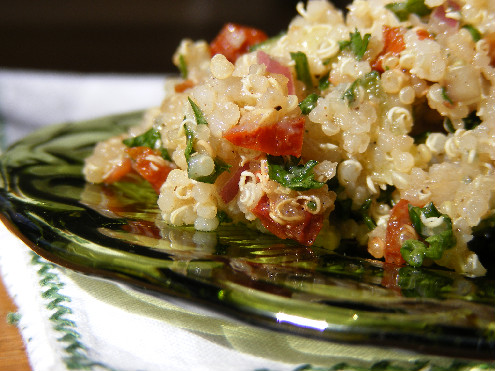
Parsley: Sun-dried Tomato Quinoa Tabbouleh

Thursday, June 24th, 2010

Sun-dried Tomato Quinoa Tabbouleh_ForkFingersChopsticks

Parsley is one of my favorite herbs.

Growing up, however, the only time I remember parsley on my plate was as a green garnish that I pushed to the side. Then, years ago when I began eating Middle Eastern foods like tabbouleh, the herb found a regular place in my heart and garden.

I grow both curly and flat parsley and prefer the curly version for tabbouleh.

Parsley’s exact origin is uncertain but is believed to have been in the Mediterranean region, from Spain to Greece and its use has spread throughout the world for both culinary and medicinal uses.

There is also much folk lore surrounding its use – one particular belief was that the herb would only flourish in gardens where a strong woman presides over the household.  Snap!

The herb is a key ingredient in several cultures including those from the Middle East and North Africa. It’s essential in the refreshing salad tabbouleh (also spelled tabouleh, tabbouli, tabboule) that has its roots in Lebanon and Syria.

Traditionally the dish has parsley, mint, tomatoes, bulgar wheat, lemon juice, olive oil and seasonings such as allspice and cinnamon. It’s often eaten by scooping it up in lettuce leaves. In the Middle East, it is more of a green salad than a grain salad.

Over the last several decades the salad has grown in global appeal, which has led to a variety of interpretations – such as in North Africa where the cracked wheat is substituted with couscous – and, here in my Colorado kitchen, where this recipe uses quinoa. When I don’t have garden fresh tomatoes, as in now, I use sun-dried. My tomato plants are growing at a snails pace, or so it seems. I created this recipe for a local magazine spread and for those eating gluten free.

Tabbouleh makes a great snack, side dish or a complete meal with hummus or falafel.

Tidbits on Parsley:

  1. There are three common varieties of parsley: curly, flat (Italian) and Hamburg. Parsley is rich in vitamin C and iron.
  2. Parsley is related to carrots, parsnips, and celery.
  3. Parsley has an honored place in folk lore and history:  parsley was used in Greek and Roman ceremonies; it was sprinkled on corpses to abate stench, Greek athletes were crowned with parsley and during the Middle Ages it was credited with lethal powers – pulling parsley root from the earth while calling out an adversary’s name could cause death. It was also believed to promote menstruation, facilitate childbirth, and increase female libido.

Sources: “Parsley,” The Gale Encyclopedia of Alternative Medicine, Ed. Laurie J. Fundukian; Encyclopedia of Spices at theepicentre.com; the Encyclopedia of Food and Culture

(more…)

Print & If you liked this post, please share:
  • Print
  • email
  • Facebook
  • Twitter
  • StumbleUpon
  • Digg
  • del.icio.us
  • Google Bookmarks

Quinoa: SAME Cafe’s Golden Sunshine Quinoa Salad

Tuesday, January 12th, 2010

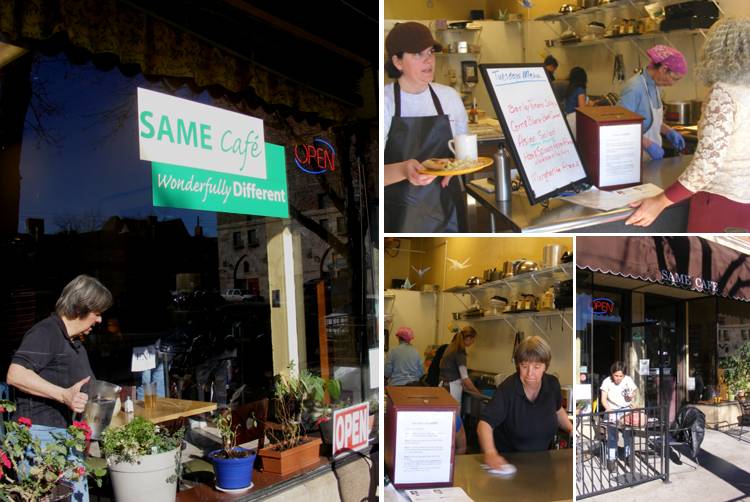
SAME Cafe - Denver Nonprofit_ForkFingersChopsticks.com

This post is my introduction to quinoa. It’s a little out of the ordinary because SAME Café is out of the ordinary . . .

It’s a sunny winter day in Denver, still several minutes before the doors open at SAME Café and there’s a line of people forming outside on this East Colfax sidewalk. The group is a mix of sorts – several in tattered clothes, others in suits, and a few hip folks with piercings and tattoos. They are here for lunch. This, however, is no regular café.

SAME is short for “So All May Eat” and the unusual mode of business here is that people pay what they want. Yeah, that’s right, there’s no set menu price. And, for folks who can’t pay, they can work in exchange. There’s no cash register, just a donation box where people pay what they feel their meal was worth. And, if a person can, leave a little more to help out someone less fortunate.

The nonprofit has been open for three years. In 2009, SAME served over 18,500 meals; since it opened – almost 35,000 meals. It is not a soup kitchen. It’s a communal concept based on dignity with good food at its core. A typical menu looks something like this:  Zuppa Tuscana Soup, Beer Cheese Soup, Chicken Salad, Golden Sunshine Quinoa Salad, Sausage & Mushroom Pizza, Apple Walnut & Bleu Cheese Pizza, and cookies. The menu changes daily and focuses on seasonal ingredients with vegetarian options always offered in the daily menu of soups, salads and pizzas.

This month SAME Café was recognized with the Channel 7 Everyday Hero Award and also an impressive MSN Hometown Heroes Award, an online viewer voting contest connected to their NBC Nightly News segment with Brian Williams (watch the video).

SAME is the brainchild of Brad and Libby Birky who were concerned about the hunger issue here in Denver. The two work full-time at the café, along with one part-time employee and the many volunteers who help with meal preparation, cleaning and numerous miscellaneous tasks.

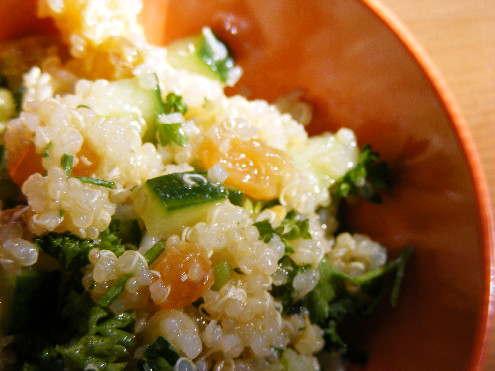
Notably, Libby is also the “Salad Queen” and she generously allowed me to come observe her in action as she prepared the quinoa salad. Her recipe is below with my measurements/ratios (she made a gargantuan bowlful; the recipe is adjusted for a smaller quantity). The salad is refreshing with the citrus-based dressing, fresh parsley and sweet raisins. For those unfamiliar with quinoa salads, this version is tabouleh-esque.

How to Support SAME:

2010 is off to a busy start at SAME. The economic downturn is one reason, as is the season – when the temperatures drop the café sees more people in need of a warm meal. Here’s how you can support their mission:

  • Go in to eat. The food is lovely, particularly the salads and soups!
  • Email them about volunteering
  • Make a donation, financial or in-kind (see their wish list in their weekly blog)
  • Spread the word (share this post with friends and colleagues – see the green icon below). Their meal count helps their funding prospects.

Golden Sunshine Quinoa Salad_ForkFingersChopsticks.com

(more…)

Print & If you liked this post, please share:
  • Print
  • email
  • Facebook
  • Twitter
  • StumbleUpon
  • Digg
  • del.icio.us
  • Google Bookmarks